Showing posts with label haunted cemeteries. Show all posts

Monday, June 29, 2026

The Weeping Woman of Ashland Cemetery

Photo by Theresa
June 2026

I recently made the short trip to Ashland, Ky to attend an awesome presentation at the Boyd County Library. Certified Cryptozoologist, Lacey Williams, gave a wonderful talk titled Bluegrass Beasts, covering a variety of interesting Kentucky creatures. But, before the presentation, I decided to get to town early...

Although I'm less than an hour away from the Ashland area, I don't get down to that area too often. So, when I decided to head that way for Lacey's talk, I wanted to optimize my trip time by visiting at least one spooky local legend. I chose to visit the Ashland Cemetery and seek out the legend of the Weeping Woman. 

Ashland Cemetery is located along Belmont Street. Dedicated back in 1870, this massive cemetery is still receiving burials today. Spanning over 106 acres, Ashland Cemetery stands as an impressive symbol of the city's history, and with the plethora of statues and intricate tombstones, it's also a wonderful collection of art and culture. One such piece of funerary art that gets a lot of attention is the Weeping Woman. 

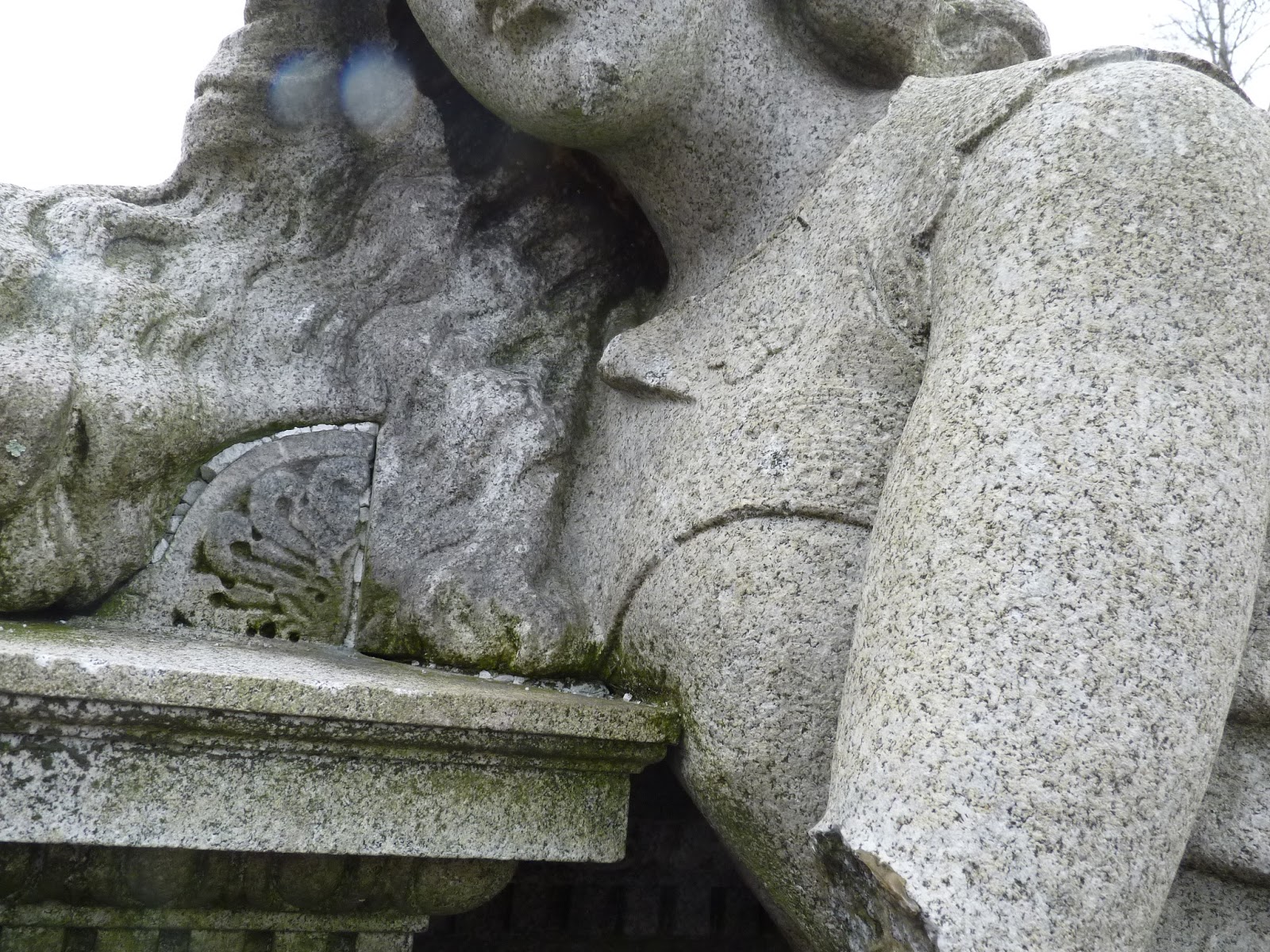
Also known as the Iron Lady or the Weeping Widow, the Weeping Woman of Ashland Cemetery is a large, seated sculpture of a woman in obvious mourning. Clutching her chest with one hand, and holding a mourning wreath with the other, she appears to be in great distress, lamenting the loss of the couple she watches over. 

Photo by Theresa
June 2026

From what I can gather, the artwork is by the famous Hans K. Schuler, a German-American sculptor and monument maker known for his work around Baltimore and Washington, D.C. and was commissioned to stand over the graves of Ferdinand Carl Fischer and his wife, Elizabeth Ringo Fischer. 

Sarah Elizabeth Ringo was born on December 22 1877 in Clinton, Kentucky to parents Willis Lunsford Ringo and Sarah/Sallie Cresap. Willis was a former Secretary of State for Kentucky and a prominent citizen throughout his life, with interests in the railroad and local improvement councils. He was also a Confederate veteran. Willis, his wife,  and many other members of the Ringo family are also buried in the Ashland Cemetery nearby the Weeping Woman. 

Ferdinand Carl (F.C.) Fischer was born in Cincinnati on July 2, 1857, making him twenty years older than Elizabeth. The two married on June 30, 1896 in Ashland, Kentucky and were blessed with a couple of children. Unfortunately, F.C. would not be long for this world. He passed away September 10, 1906 at the age of 49, leaving his 29 year old wife a widow to raise two small children. According to an article on the Kentucky Kindred Genealogy website about the Willis Ringo family, Elizabeth did remarry. On June 27, 1908, she married Alexander Blucher D. Gordon III, who would go on to outlive her by seven years. 

I'm not sure what her relationship with Alexander was like, but the two did have an additional son together. However, when Elizabeth died on March 20, 1952 in Pennsylvania, she was brought home to be buried by F.C. in her family plot at the Ashland Cemetery. Today, Elizabeth and F.C. lie side by side under matching stones, with the Weeping Woman keeping watch above. 

And, for many years, stories have spread that the Weeping Woman statue may be more than just a statue. Across multiple Face Book and Reddit posts, blogs, and even Instagram stories, nearby residents and visitors to Ashland Cemetery are sharing very similar experiences with hearing the unmistakable wails of a woman in mourning.  

Some individual accounts have been curated at two awesome blogs, The Southern Spirit Guide and Black Flag Horror.  One of my favorite accounts involves a man named Ronald Hinton who was visiting the grave of a loved one in autumn when he heard a woman sobbing. Following the sound, he found a woman seated nearby several graves with her head down, wailing in mourning. As he approached her, she lifted her head and reached out a hand towards him. He could see the tears streaming down her cheeks from her closed eyes, and even drool pooling at the corners of her mouth. But, as she opened her eyelids, he immediately saw that she had no eyeballs! 

Photo by Theresa
July 2026

Taken aback by this, but still wanting to help, he went to get several other visitors who were at the cemetery that day to help him with the strange wailing woman. As the group arrived back, the once-living woman was now simply a statue---The Weeping Lady Statue. 

Although she is mostly heard, Ronald isn't the only one to have seen the woman appear as a living person. Legend tells that on the full moon she arises and walks the cemetery, crying out in grief. But who is she wailing for? The obvious reason might be the Fischer family, particularly F.C., as the statue is of a grieving woman and Mrs. Fischer did lose who husband at a young age. Or, there may be another reason.

The Ashland Cemetery is the final resting place for Emma Carico/Thomas, Robert Gibbons, and Fannie Gibbons. The three young people were murdered on the night of December 23, 1881 by an axe and the house they were staying in was set ablaze to cover it up. Seventeen year old Robert and his 15 year old sister, Fannie, were the only members of the family at home, and were being visited by Fannie's 15 year old friend, Emma. The perpetrator was the Gibbons' own father, who had been suffering from mental illness and suicidal/homicidal tendencies following domestic troubles with his wife. This event became known as the Ashland Tragedy, and rocked the city. Could the wails and cries actually be for these three young people taken so violently as some believe?

You can visit the Ashland Cemetery during daylight hours and see the Weeping Woman for yourself! She sits nestled among some bushes in Section 13...Listen closely and you might hear the unmistakable wails of a woman in mourning. 

Sources and Further Reading:

The Southern Spirit Guide: Moaning and Crying-Ashland Kentucky. January 6, 2020, by Lewis O. Powell IV.

Black Flag Horror Wordpress: The Weeping Lady

Kindred Genealogy: Willis Lunsford Ringo Family

Wikipedia Article on Hans Schuler

Find-a-Grave: Ashland Cemetery 

Find-a-Grave Pages for: (Willis Ringo) (Elizabeth Fischer) (F.C. Fischer)


29 December 1881
Ashland Daily Independent 


Monday, January 5, 2026

The Curse of the Bronze Lady


Photo from Find-a-Grave
Submitted by Jan Franco


Deep in the heart of Headless Horseman territory and located within the same cemetery where author Washington Irving lies, is an often-overlooked legend. It is the Curse of the Bronze Lady of Sleepy Hollow Cemetery.

When General Samuel R. Thomas, a wealthy coal and railroad baron and Civil War veteran, passed away from heart disease suddenly on January 11, 1903, he left behind three children and a widow. Samuel married Ann Porter in 1872 and was obviously deeply grieved over losing her beloved husband. She initially had him buried in a private mausoleum/crypt but felt that a man of such wealth and stature deserved a more fitting memorial. 

She hired sculptor Andrew O'Connor who created the bronze statue of a woman, seated in mourning. He named the statue appropriately 'Grief.' Unfortunately, Ann was appalled by the work. She believed the face was too melancholy and dismal; she wanted a happy countenance overlooking her husband's final resting place. (Theresa's side note: No one really knows why Ann was so persistent about having a 'happy faced' statue, but I'm kind of wondering if the mourning widow wasn't as unhappy as she wanted people to believe. After all, she had actually been left out of Samuel's newspaper obituary altogether! Or perhaps this was just a way to get out of paying the princely sum of money it would have cost her to commission such a piece.) Either way, Ann was displeased, and demanded O'Connor try again.

O'Connor obliged and created a second head for the statue, one with a more cheerful look. Ann approved of the new design, but it never made its way onto the statue. Instead, O'Connor hurled the head to the ground, where it smashed to pieces at Ann's feet (very Headless Horseman coded). He basically told her that his first design was perfect, and how dare she question his art. 

Photo from Find-a-Grave
Submitted by David M. Habben

And so, the Bronze Lady retained her original face. Ann would pass in 1944. Her body was cremated, and her ashes were interred in the mausoleum alongside her husband's body. Shortly after, the legends of the Bronze Lady curse would arise. 

Gaining popularity throughout the 1960's, 1970's, and 1980's, especially with local teenagers, the legends of the curse are quite varied, depending on who is telling the story. There are those who state that anyone foolish enough to insult the statue or slap its face is instantly cursed. A simple touch of the cheek is enough to warrant a long run of bad luck. But it's when one chooses to sit in the statue's lap that things get REALLY weird. 

Some say that simply sitting in the lap at all is curse-worthy. Others say if you sit on her lap, jump down, and spin around three times, you'll be cursed. In another variant, those same actions are believed to BREAK the curse, should it be acquired through some other means. I especially like the variant where if you sit on the statue's lap and then go look into the keyhole of the mausoleum, you'll see a ghost!

Yeah, sometimes the Bronze Lady doesn't want to 'curse' you.... she just wants to be spooky. She may give you the ability to see ghosts through the keyhole, or she might simply be seen walking around the cemetery on dark, moonless nights. If she isn't seen, she may be heard; the mournful cries of the Bronze lady will get louder the closer you get to the burial site. In yet another variant on the lap-sitting, legend says that if someone sits in her lap, she'll cry tears of blood. And, back to the mausoleum itself, if you're not brave enough to look through the keyhole for ghosts, perhaps you'll be brave enough to knock on the door. You won't see ghosts, necessarily, but you'll be plagued with bad dreams. 

If you ever find yourself in the Sleepy Hollow Cemetery, visiting the grave of Washington Irving, or one of the many, many other famous authors and others to be buried within this hallowed ground, don't forget to stop by and pay your respects to the Bronze Lady. At the very least, DON'T INSULT HER!

Sources and Further Reading:

Find-a-Grave Entry for Samuel R. Thomas

The Bronze Lady of Sleepy Hollow: NY Ghosts Blog. 13 May 2025

The Bronze Lady: The Other Spooky Legend of Sleepy Hollow that You've Never Heard Of. The Lineup. Article by Jessica Ferri. Published 24 October 2017


Times Union (Brooklyn, NY)
12 January 1903


Wednesday, September 3, 2025

Forest Dale Cemetery's Not-So-Ghostly Ghost

Entrance to Forest Dale Cemetery
Malden, Mass
Photo by Find-a-Grave user (LMJ)

The Forest Dale or Forestdale Cemetery in Malden, Massachusetts is picturesque tribute to the city's former residents. Laid out in 1884 by Boston surveyor, F.R. Page, the cemetery was formally dedicated on Memorial Day of 1885. For many years, the cemetery was also adjacent to property operated by the county alms house and 'Contagious Hospital'. It was one of the patients at this hospital that gave one passerby quite a fright back in 1915!

It was early in the morning when milk dealer, Isaac Cohen, passed by the cemetery on his route. What he saw, however, shocked him awake. Rushing through the cemetery at break-neck speed was a white figure. After rubbing his eyes and assuring himself that he wasn't just seeing things, Cohen made a hasty decision to follow the fleeing figure. 

As he caught up to the figure, he was probably pretty relieved to see that he hadn't been chasing a ghost at all. Rather, he had caught up with 14 year old Ivan Clark. Clark was a patient at the nearby Contagious Hospital and had escaped out a second-story window around 3 am when a nurse woke him up to give him some medicine. Cohen turned the kid over to authorities, and he was returned to the hospital to continue treatment for his diphtheria. 

Clark has to be commended for his extreme elusive action as he definitely didn't want to be confined any longer to the hospital, which is completely understandable. However, I think if I was Cohen, I'd have much rather had a run-in with a ghost than a living person with a presumed highly contagious and potentially fatal disease! 


The Sunday Telegram (Clarksburg, WV)
4 July 1915


Monday, April 21, 2025

The Glowing Tombstone of Pittsburgh

Tombstone of Giovanna Cecere
Photo by Find-a-Grave user, Roseanne Kocinski-Fowler

Giovanna Cecere was born on June 23, 1929 in Pittsburgh, Pennsylvania to parents Mr. and Mrs. Frank Cecere. She was one of at least seven children. Unfortunately, a heart condition would end her life far too soon. She passed away on October 27, 1948 at the age of 19 and was buried in St. Michael's Cemetery. But, she would not rest in peace for long.

On Friday, July 31, 1953, hundreds of curiosity seekers flocked to the cemetery to catch a glimpse of a spectacular sight. A few days before, Mrs. Germaine Woods of 117 St. Paul Street, noticed something strange. It was an eerie yellow-green glow, coming from a tombstone in St. Michael's. That tombstone would, obviously, turn out to be that of Giovanna Cecere. As word spread about the strange phenomena, a throng of onlookers began arriving, and police were called in to help control the situation. That night, Police Inspector Paul Mozuch showed up to control the crowds, as well as try to figure out just why the tombstone was glowing. According to his observations, the tombstone itself was made of a highly polished red marble. No paint or powders were present that would explain the glow. Further, it didn't seem that the stone was reflecting any nearby lights.

The glow seemed to come from an area around the porcelain portrait of Giovanna which was on the tombstone. Weirdly, the glow wasn't observed to those standing in front of the tombstone, or anywhere IN the cemetery for that matter. The glow was only observed from a spot on St. Paul Street, about half a mile away.

Also called in that night, was George Cecere, the brother of Giovanna, who lived nearby, as well as the parish priest. The priest covered the tombstone, which extinguished the glow, then blessed the grave with holy water, leaving it covered.  George and Mozuch stayed until 3 am that night, keeping watch over the grave.  However, that was merely the beginning of a weekend full of onlookers.


Pittsburgh Post-Gazette
03 August 1953

Each night, the gates to the cemetery were locked, and the tombstone was covered up. That didn't stop people from showing up, though. Worse yet, it didn't detract treasure hunters from trying to chip away at Giovanna's stone, especially her portrait. Chicken wire was put up around the gravesite and padlocks (which were broken off) locked up the gates. Patrolman Michael O'Toole and Acting Lt. John Perich were on site Sunday to direct traffic and replace the covering that kept being removed. 

The church's official stance was that this whole thing was the result of crazy rumors, and was not supernatural, nor miraculous in nature. Inspector Mozuch personally believed that the tombstone's glow was a result of the stone absorbing the sun's rays all day long. Norgal Hoger, a chemist who had not observed the stone in person, gave the explanation of 'fox-fire' as it was a common phenomenon in cemeteries. Whatever, the cause, the mania would eventually die down. Today, Giovanna once again lies in rest. She is joined by her sister, Mary Jo, who shares the tombstone. What is conspicuously missing, however, is the porcelain portrait that once graced the tomb and was said to be the center of the mysterious glow. Was it removed by the family to put the rumors to rest...or did one of those treasure hunters actually walk away with a prize?

"The glowing tombstone" is a popular trope in paranormal research, and with the glow centering on the tombstone portrait, I can't help but think about West Virginia's 'Devil Baby of Ravenswood,' in which a similar portrait was the root of a spooky legend. Feel free to go check out that blog post as well, and if you visit Giovanna or little George (The Devil Baby of Ravenswood), please remember that these were real people...not just ghost stories. Treat them with the respect they deserve. And as always, happy haunting. 


Giovanna's Obituary
Pittsburgh Sun-Telegraph
28 October 1948


The Pittsburgh Press
01 August 1953


The Star Press (Muncie, Indiana)
02 August 1953

Wednesday, January 8, 2025

The Haunted Hatfield Cemetery

Levisa Hatfield, wife of Devil Anse

Even those far removed from the tri-state area are familiar with one of the most famous feuds in history: The Hatfields vs. McCoys. With such a long and violent history, there has to be more than a few ghost stories associated with these two warring families, and one such story in particular involves the final resting place of much of the Hatfield clan.

Located in the Sarah Ann area of Logan County, the Hatfield family cemetery sits high up on a hill. Overlooking generations of Hatfields stands an imposing statue of William Anderson "Devil Anse" Hatfield, the family patriarch. The statue faces Island Creek and is oriented with his back "forever turned upon the Tug Fork Country and the McCoys".

"Devil Anse" was born on September 9, 1839. The reason for his colorful nickname is unknown, but plenty of theories have been put forth, including it being a testament to his bravery during his service to the Confederate Army during the Civil War. As part of his allegiance to the cause, Devil Anse helped found a group of Home Guards, known as the Logan Wildcats, to protect the Tug Fork area. This group was responsible for the murder of a member of the McCoy family, home on medical leave from the Union. Although relations between the two families were already rocky, this act of violence further fueled the feud.


Hatfield Family Cemetery ca 1925
Source: WV History on View

After the war, Devil Anse bought up some land in the area, and became prominent in the timber business...as well as in the illegal moonshining business. Meanwhile, the feud between the families raged on, resulting in his being complicit in several additional murders of McCoys.  On September 23, 1911 he publicly tried to turn his image around and was baptized by the famous mountain preacher, William Garrett in nearby Island Creek. 

On January 6, 1921, Devil Anse succumbed to pneumonia in his Sarah Ann home. But, even the grave couldn't keep ol' Devil Anse down. 

It is said that on dark and foggy nights, the spirit of Devil Anse steps down off his tombstone pedestal and rallies his men, mainly his nine sons, and makes his way down the hillside. Drivers going past the cemetery have seen a group of men congregating by the small bridge near the cemetery sign. Here, the spirits await William Garrett to also arise from his grave, where he baptizes them in the small creek. Upon their posthumous baptism, washing away their sins, the spirits disappear, only to repeat the process over and over through time.


Sources and Further Reading:

Devil Anse Hatfield Wikipedia

WV Ghosts and Legends

Find-a-Grave: Hatfield Family Cemetery


Saturday, January 4, 2025

The Flaybrick Clown Ghost

Female Pierrot Clowns
Source


Clowns are scary. Even those without coulrophobia can admit that clowns, especially ones popping up when and where they obviously don't belong, are at the very least, unnerving. But what happens when those creepy clowns are...ghosts?

It all started on Thursday, June 3, 1937. Mourners were gathered at the Flaybrick Cemetery in Birkenhead, England. They were there to lay to rest Charles Fry, a pilot who was killed a few days earlier at the start of the London to I.O.M. air race. However, before the coffin was lowered into the plot, a lady in attendance noticed that the wrong grave had been opened. The grave was that of Fry's uncle, not the family plot in which he was supposed to be interred. 

With the mistake caught, grave diggers got busy opening the correct grave. Many of the mourners decided to call it a day, but a handful waited the two hours it took to remedy the mistake and pay their last respects to the deceased. This much of the story is true. It was even noted in several local papers. What those same papers failed to include was the horrific scene that was said to take place during that two hour wait. 

A woman showed up, dressed as a Pierrot clown. She laughed and joked and even mocked the undertaker's mistake. The remaining mourners couldn't believe that this obvious lunatic would act so disrespectfully at a burial ceremony, and tried to chase her away. Oddly, she disappeared and then reappeared behind tombstones in another section of the cemetery. Before leaving she even threw urns and flowers at the mourners. 

One of the gravediggers, an older man, addressed the mourners. What they witnessed wasn't an insane, living woman. What they had witnessed was a ghost, and he had seen her before, back in 1910 dressed in the same costume. 

The legend of the Flaybrick Ghost Clown would not be put to rest with Mr. Fry that summer day in 1937. She would be seen at least twice more in the 1990's. In the summer of 1995, a group of teenagers stuck over the cemetery wall late one night to play hide-and-seek. A fourteen year old girl was hiding behind a large, marble cross when she saw a shadow approaching. The shadow belonged to a woman, about 5'7'' wearing a white silk clown suit with pink pom poms and matching cap. Her face was caked thick with white makeup.

The clown lady swore at the girl to stay away from her grave. Understandably, the girl tried to take off running, but tripped and fell. It was then that she felt a gloved hand around her throat. She got loose and was able to run off and flee the cemetery with her friends following behind.

The following year, a news reporter and photographer were driving past the cemetery in order to cover a story about a local dam that was leaking. Over the top of the high cemetery wall leapt a woman dressed as a clown, running directly in front of their vehicle. The driver avoided hitting the woman, but nearly crashed in the process, as the clown easily leapt back over the 6 foot tall cemetery wall. Seeing the accident, an older gentleman came over and told the news crew that they had just witnessed the Flaybrick Clown Woman. No, she wasn't insane; she was dead. 

Sometimes seen playing a guitar or ukelele, the clown is always dressed the same in her old-fashioned Pierrot clown garb. Locals and researchers alike have tried to identify the clown lady, but to no avail. The legend of the Flaybrick Clown remains unsolved. At best, she's a rather rude ghost who will interrupt a funeral with jokes, laughter, and unsolicited ukelele music. At worst, she's a menace to society, causing car crashes and throttling teenagers.   Whichever version of her behavior you get, you have to admit that it's creepy AF. 

Sources and Further Reading:

Flaybrick Memorial Gardens Website

The Clown Ghost of Flaybrick YouTube (BouncyClown)

Burials and Beyond

Haunted Wirrel with Tom Slemen (Wirrel Globe, 07 March 2018)

Liverpool Echo
3 June 1937


Tuesday, September 26, 2023

The Bleeding Tombstone of Appleton, Wisconsin

Photo by Find-a-Grave Contributor 
Matthew J. Preissner


It's Spooky Season here on Theresa's Haunted History of the Tri-State, but also in my own home. Well, it's Spooky Season for me year-round...but beginning in mid-September, I'm finally able to get my kid on-board. One of the ways we 'celebrate' is to take advantage of the 10-15 minutes we have each weekday morning waiting in the school drop-off line to watch a quick video about a spooky legend or story. We really like the videos of Jessii Vee, who recently did a story on a cursed tombstone located in Appleton, Wisconsin! 
The tombstone in question sits down a secluded path in the Riverside Cemetery of Appleton, WI. The plot sits by itself overlooking the river, but the tombstone is a large, beautiful piece of art which was undoubtedly quite expensive in its day. If you're lucky enough to stumble across this tombstone, you've stumbled across the final resting place of Kate Blood. 

There are those in town who swear that by the light of a full moon, blood will drip down the face of the tombstone, oozing over the engraving of Kate's name and birth/death dates. Others will say this stone gives off an eerie heat, even  in the coldest weather. Some have even sworn to see an apparition of a woman crouching behind the tombstone, as if hiding from the prying eyes of anyone who dares approach the grave. 

Like many cursed tombstones around the country, the grave of Kate Blood comes with an accompanying back story that tries to validate the activity. In the most popular version of the legend, Kate was a murderous witch. She killed her husband and three children with an axe, before taking her own life. As a result of her misdeeds, she was buried away from the rest of the cemetery. In an alternate version, Kate's husband murdered HER, and presumably, the bleeding tombstone is a reminder to all of the tragedy that took her too soon. 

While actual history doesn't line up with either versions of the legend, it is true that Kate was a young woman who was taken from this world too soon.

Kate Marcia Blood was born on May 4, 1851. Her parents, Colonel Henry L. and Theresa Blood, were some of the earliest settlers in the area, responsible in part for laying out the town. Kate, or Kitty as she was known, was one of the first children born into the new fledgling community. As she grew into womanhood, she would marry George Miller, editor of the local newspaper, the Appleton Post. She was described by all who knew her as beautiful, accomplished, sweet and amiable. She came from a good, Methodist family, and was beloved by all who knew her.

Unfortunately, she would take ill with the dreaded consumption (which we call tuberculosis today). In an effort to try to cure her disease, her family took her on a trip. She became one of thousands in those days to head for Colorado, believing the state's fresh air had a curative effect on consumption. She never made it. While making a stop in Lawrence, Kansas, Kitty Blood Miller passed away. Her date of death is listed as either December 28th or December 29th, 1874. 

Kitty's body was brought home by train and the town mourned her death. She left behind a young daughter of two years of age, as well as her husband, George. She was only 23 years old. 

The town moved on, and George moved on, remarrying and living another 40+ years. But, by the river in Riverside Cemetery stood a stone monument with the name Kate BLOOD boldly emblazoned on it, sparking a legend that would endure for decades. But, Kate isn't the only BLOOD  who has had an unfortunate claim made about them based largely, if not solely, on the idea of their name alone. While Blood is a common English surname, it can be a little...jarring...seeing it on a tombstone.

West Virginia has its own bleeding tombstone legend, located in Huntington's Woodmere Cemetery. Here, near the main entrance, is the grave of Edith Blood, known as Mother Blood, a rumored midwife with a penchant for murdering babies. Again, there is no historical basis to the legend, and a perfectly reasonable explanation for the rust colored stains that actually do mar the surface of the tombstone. You can read all about THAT legend here: (Legends of Woodmere Cemetery: Mother Blood)

Sources and Further Reading:

Collar, Jim. Kate Blood: The Woman Behind the Urban Legend. Post Crescent (October 28, 2015)


Appleton Post
7 January 1875


Saturday, April 9, 2022

An Industrious Spook

Huntersville Confederate Cemetery
Photo by Find-a-Grave user, Dixon in Dixie

An Industrious Spook...that was the title bestowed upon this article, found in the January 18, 1894 edition of the Shepherdstown Register, describing a ghostly wagon driver seen outside of Marlington, West Virginia. Originally appearing in the Pocahontas Times, the story goes as follows:

"A ghost was undoubtedly seen in Marlington last week.  A citizen of the suburbs of the place was awakened after the turn of the night by his dogs, which were in the house with him; one of these dogs is large and most ferocious and was giving blood-curdling growls as he endeavored to get out of the house. On hearing the noise of a wagon slowly passing, he he looked out and saw a man drawing a light wagon, without apparent effort, up hill and through the mud. Passing the house he ascended the hill and was gone long enough, probably, to have reached the Soldiers' Grave Yard, on top of the hill, when he was seen to return and pass the house in the same mysterious manner.  The contents of the wagon could not be distinguished. The night was bright and starlight, but on the "bottoms" the mist was lying low and heavy. He was seen to enter one of those clouds and so disappeared. There is no residence on this road for five miles after passing the gentleman's place referred to. All in that house saw and marked the strange appearance well. --Pocahontas Times"

It seems as if the author of this article is trying to imply that the mysterious contents of the wagon were possibly a deceased soldier, being taken to the burial ground to be interred by a phantom wagon driver, who then mysteriously disappeared into a cloud of mist. After a bit of frustrated searching, I BELIEVE this Soldiers' Grave Yard mentioned in the article is the Huntersville Confederate Cemetery, located about five miles away from downtown Marlington in Huntersville, WV. The Find-a-Grave page for the Huntersville Cemetery provides an excellent historical write-up, which I definitely encourage you to go read in full.

In short, however, during the early part of the War Between the States, several Confederate soldiers stationed in the area passed away from illness---most likely, typhoid fever---and were buried on this hill top. After the war, the cemetery was largely forgotten and abandoned, with only a few local citizens in the area even knowing exactly how to find it. In the 1990s, a group, led by Civil War re-enactor Mike Sheets, cleaned the area up, but it was soon reclaimed by the surrounding forest land. But, with the new millennium, came a renewed interest in the old burial ground, when a descendant from out of state was researching her Confederate ancestors.  The cemetery is now accessible to the public, with monuments and interpretative signage.

Because of the efforts of so many in the community and elsewhere, namely Mary Jo Fisher who did a ton of research, we now know the names of quite a few soldiers buried in this cemetery. But, what we DON'T know is who our phantom wagon driver may be...and which unfortunate soul he was seen carrying to his final resting place, OVER 30 YEARS LATER. 

For more information, also check out THIS AWESOME ARTICLE, by Suzanne Stewart for the Pochontas Times. It's about one of the dedication ceremonies held at the cemetery, and mentions some background on some of the soldiers buried there. 


Wednesday, March 2, 2022

A Gruesome Grave Robbing in West Virginia

Find-a-Grave
Uploaded by Tammy Parks Markwood

Ghoul: n. An evil spirit or phantom, especially one supposed to rob graves and feed on dead bodies.

When I hear the word 'ghoul', that's the definition I usually associate with it, but throughout history, the term has also come to be a description of those flesh and blood living humans who engage in the heinous act of disturbing buried bodies. It was these types of ghouls that had a small community in Preston County, WV outraged.

Mary Ellen Shaffer Calhoun was a well-known and well-respected elderly widow living in the community of Newburg. When she passed away on January 27, 1916 at the age of 78, she was buried in the Calhoun Family Cemetery near Manheim, beside her husband, John G. Calhoun. There she laid in rest...for about two weeks. 

February 11th, 1916 was a Friday. That morning, two boys, Kramer Brandau and Harold Painter, were on their way to school in Rowlesburg. On route from their homes in Manheim, they passed the Calhoun Family Cemetery and noticed a big pile of fresh dirt and wooden boards strewn about. Being a small community, they knew that there wasn't a recent burial, so they walked over to check it out. To their horror, they found the body of Mrs. Calhoun, partially nude, lying above ground. The wooden case enclosing her casket had been smashed and scattered. The coffin lid and nameplate had been removed. The body, although outside of the coffin and lying on the ground, was left intact. However, the clothes had been partially torn off and ripped to shreds. 

The boys ran all the way to Rowlesburg to report the incident to authorities. It wouldn't be long before Sheriff Laco Wolfe, accompanied by a pack of bloodhounds belonging to Sheriff Ross F. Stout were on the scene. Dim footprints were found in the mud, but unfortunately, the dogs were unable to sniff out the trail of the alleged grave robbers. Mrs. Calhoun's body was placed in the care of the local undertaker, who hastily reburied her with as much dignity as the situation could merit. 

Local rumor believed that Mrs. Calhoun was the victim of grave robbers because she was buried along with expensive jewelry, valuable papers, and even perhaps a large sum of cash. Local newspapers covering the story even first reported that rings were violently cut from her fingers and stolen by the grave robbers. However, all this would prove false. The family claimed that she wasn't buried with her jewelry, and she certainly wasn't buried with CASH. These rumors may have been started when Mrs. Calhoun's oldest son, Albert Dodson (AD) Calhoun, who was named administrator of her estate went over all the assets on February 5th. In doing so, he discovered that his mother had never cashed or deposited a check for $400 that he had written her 18 months prior for debts he owed her. Upon discovering this and checking with the First National Bank of Grafton, he reissued a check in the same amount to be paid to the estate. However, he claims that no one, not even other family members, were aware of this transaction.

So what was the motive for this horrific crime?

Perhaps the motive was robbery. Mrs. Calhoun seemed to be a very well-known figure in the community, and she probably had some wealth to go along with her reputation. Maybe the grave robber(s) thought she WOULD be buried with jewelry and/or other items worth stealing. That would account for the disarray of the clothing/shroud as the robbers hastily tried to find what they were looking for. However, a strange article came out in the February 12, 1916 edition of the Daily Telegram. This paper claimed that Mrs. Calhoun was disinterred in such a disrespectful manner because of SPITE. It was noted that the body was found in a field near the railroad tracks...the same railroad tracks traveled daily by her son, H. Calhoun who was a conductor on the Morgantown and Kingwood Railroad. 

That's an interesting take on the whole situation, but I never found out what in the actual hell Mrs. Calhoun or her family had done to make someone want to hurt them and disrespect them in such a gruesome manner. Digging up a corpse and leaving it out where it can easily be found by two young boys on their way to school is absolutely horrific. For one to do so out of spite is the sign of a pretty twisted mind.

Whatever the reason behind the gruesome event, it doesn't appear that the case was ever solved. On February 19th, the Martinsburg Herald basically stated that the case had gone cold and all leads exhausted. However, on the following day, the Sunday Telegram ran a small article saying that all clues had been exhausted, BUT an unnamed hypnotist/mind reader was being called in as a last resort to uncover clues. After that, it seems that local papers dropped the matter, and I couldn't find any additional mentions in the sources I regularly use. 

This story may seem a little more...gruesome...than what you're used to seeing on Theresa's Haunted History of the Tri-State. And although it's not paranormal, it is WEIRD---weird and spooky. I love branching out into ALL aspects of West Virginia's strange and fascinating history and thought a tale of grave-robbing might be something YOU'D be interested in as well! Lemme know down in the comments what YOU think of these types of stories, and as always, let me know what kind of content you'd enjoy reading about. 

Sources:

The West Virginia Argus. 17 February 1916

The (Clarksburg, WV) Daily Telegram. 12 February 1916

Martinsburg Herald. 19 February 1916

The Sunday Telegram. 20 February 1916. Accessed through Newspapers.com 

BONUS GHOST STORY:

As a paranormal researcher/investigator, I was REALLY hoping I could find some ghost stories associated with the Calhoun Family Cemetery, or tales of it's reputed haunting. How cool would that be to find documentation that this lil' location has a history of being haunted...and making the connection that this tragic tale could be behind it.

Unfortunately, that wasn't to be. But, I did find a very, VERY brief mention of another cemetery being haunted! Mrs. Calhoun was apparently living in Newburg, WV at the time of her death. Newburg is a good 30 minutes away by today's standards from her burial place between Manheim and Rowlesburg. Newburg is also home to an allegedly haunted cemetery of its own! The Damon Cemetery (sometimes referred to as the Knights of Pythias Cemetery) is haunted by the ghostly apparition of a lady in white. A visitor to the cemetery, checking on her father's grave, also had her own personal experience in the cemetery, which was shared on the Facebook page, West Virginia's Most Haunted Places. 


Wednesday, September 22, 2021

The Witch of Wildwood

Witch of Wildwood
Photo by Robin Smith, Find-a-Grave

October 30th. The evening before All Hallow's Eve. Devil's Night. 

What would be a more fitting date to burn a witch alive? As one West Virginia urban legend states, that's exactly what happened to a witch named Kazimir Kiskis. She was burned alive, presumably for her association with witchcraft, and was buried nearby at Beckley's Wildwood Cemetery. The grave faces in the opposite direction, so that the witch doesn't have to spend eternity watching all the 'good Christians,' and they don't have to await the Resurrection looking at her.  Her spirit returns every Halloween eve to haunt the place where she was buried. For years, locals have been freaked out by the upside cross, covered in strange symbols, that marks the witch's final resting place.

As ya'll know, I love taking a peek behind the curtain of West Virginia's spookiest legends, and over the years, have found that even the most outlandish of tales often are rooted in a tiny grain of truth. Here's some truth about Kazimir Kiskis:

Kazimir Kiskis was born in Lithuania, but of Russian descent. HE was a coal miner who immigrated to the United States in 1907 and was living and working at the Lanark Coal Camp, located just a few miles from Beckley. On October 25, 1924, Kazimir Kiskis (known by his anglicized name of 'Charlie') was involved in a terrible house fire and received burns over his entire body. He lasted five long, agonizing days, before succumbing to his burns. He passed away on October 30, 1924. He was 38 years old. 

Death Certificate for Kazimir 'Charlie' Kiskis
WV Archives

Along with his strange, eastern European language and customs, 'Charlie' brought with him his religion. Charlie was a Catholic, and like many from his mother country, was probably Eastern Orthodox. Now, there are plenty of Christian sects TODAY that equate Catholicism with witchcraft, and back in the 1920's in southern West Virginia, things probably weren't much more...enlightened. Anyone who was seen as different generally was considered someone to be feared or to be ridiculed. 

Nevertheless, Charlie had a rather impressive tombstone erected in his honor, and hopefully, his funeral and burial were held in accordance with his beliefs. The tombstone actually featured a normal cross and obviously wasn't covered with symbols of witchcraft. Rather, the symbols and writing are probably a combination of Catholic symbolism and an epitaph written in Charlie's native language, Lettish. 


June 2025
Photo by Theresa

It's possible that the vandalism of Charlie's tombstone started early because of his Eastern Orthodox religion. However, I think its probably more likely that the tombstone MAY have originally broke from natural causes, and since then, vandals, wishing to add fuel and validity to the urban legend of a witch being buried in Wildwood, continue to deface the stone, turning a regular cross into an upside down one. And from there, the legend grew. 

This location is featured on Haunted Beckley's Wildwood Cemetery Tours, where the correct information behind the stone and the person buried beneath it are shared, finally giving Charlie the respect he deserves. I know it's fun to think about creepy legends, visit these locations for ourselves, and share the stories. But, just keep in mind that behind these urban legends are real people. 

Stay spooky my friends! 

Historical Information for this blog came mostly from the Find-a-Grave page for Kazimir Konstanti 'Charlie' Kiskis

Thursday, July 8, 2021

Theresa's Travels: Sistersville, West Virginia


On Saturday, June 12, 2021 myself and several other members of Spectral Research and Investigation headed north to Tyler County, West Virginia. We had been called in to assist a family in Sistersville who was experiencing some potential paranormal activity. As this was largely a daytime investigation and it was a 2.5 hour drive up there for me, there wasn't a ton of free time to explore the historic and spooky little town of Sistersville.  However, I wasn't about to let the opportunity to at least LOOK at some of the area's haunted hot spots pass me by!

My first stop of the afternoon was the historic and haunted Wells Inn. The Wells Inn opened in January of 1895 to cater to those connected with the recent oil boom in the area. It was built by Ephraim Wells, and he is believed to be the main ghost of the hotel. He is blamed for moving objects around, locking maids out of certain rooms, playing with the elevator, and the sounds of writing coming from his former office. Phantom footsteps have been heard in the halls and doors have been known to slam on their own. 

I had briefly entertained the idea of actually staying the night at the Wells Inn following our investigation, but since money's tight and time was short, I decided to skip the formal stay and wait until I had the time and money to really make the most out of my stay there. So, I had to be content to stop and take a few photos!  Unfortunately, there was a big sign on the front door saying that the lobby was open to guests of the hotel ONLY. I'm not sure if this was simply a COVID-19 restriction, or this is a permanent policy put in place for the safety and comfort of paying guests.  Either way, I was a little bummed (but I completely understood) that I couldn't go inside. 

I left the Wells Inn with the intent of heading up to Oakwood Cemetery and getting some good daytime photos of a very eerie monument known as the Stocking Lady. I'm not sure HOW I missed it, but my directions to Oakwood Cemetery did not work out, lol. I did, however, find myself in another local cemetery---Greenwood. I think Greenwood and Oakwood sometimes get confused, but I have heard some stories of Greenwood being haunted as well. In one report submitted to WVGhosts, a witness claims that a group of friends visited Greenwood and after touching one tombstone that felt hot, several girls in the group felt like they were being stabbed. White, moaning things were seen, and even approached their car! I can't vouch for these tales, obviously, but I think there was a reason why I ended up at this particular cemetery.  As I was driving around, looking at the tombstones, I actually stumbled upon the graves of more than one previous owner of the property we were about to investigate!

By the time I checked out Greenwood pretty thoroughly, it was time to meet up with the rest of the team. I was super bummed that I hadn't found Oakwood, as I REALLY wanted to see the Stocking Lady for myself, but I knew that we had a job to do, so I focused all my attention on getting ready for the night's investigation. 

The Spectral Research and Investigation team, accompanied by Zach Schwartz of Countere Magazine, met up at The Fort Pizza and Restaurant for lunch and to plan out how we were going to approach this particular investigation. I had a HUGE chicken wrap and fries. The food was good and the staff was friendly---it was a really nice little local place to gather our thoughts and decide what we needed to do to give our clients the best investigation we could. 

As this was a private residence case, I won't be going over details of our actual investigation, but I will say that it was a hard one for me, emotionally. It was a case unlike any other residential I've done over the years and although we plan on staying in contact with the family and continuing to work with them, I just personally feel like we were all stuck between a rock and a hard place when it came to really solving their problems for them. So, that was disappointing, but the evening definitely ended on a happy note!  The family actually lived pretty close to Oakwood Cemetery...and offered to take us up there!

I first learned about Oakwood Cemetery and the Stocking Lady back in October of 2019 when I saw storyteller Granny Sue at the WV Book Festival. The Stocking Lady is a beautiful, yet damaged tombstone statue that overlooks the graves of the family of Philo and Nancy Stocking. Local legend states that those who have been bold enough to vandalize the statue of a woman in a flowing garment have suffered terrible fates. The person who broke off the statue's arms lost his own arm in an accident. The person who gouged out the eye area went blind himself. There are lots of stories of people simply touching the Stocking Lady, resulting in a run of bad luck, illness, and injury. 

Oakwood Cemetery didn't disappoint and I was thrilled to finally see the Stocking Lady for myself. I didn't get too close, though...just in case. 


Overall, the trip to Sistersville was a positive experience for me. I had driven through the area before on my way to Moundsville, but never stopped to really look around. The drive along the Ohio River between Huntington and Sistersville is a beautiful drive that takes you through so many little historic towns, each with their own legends and ghost stories. This trip to Sistersville may have been my first, but it certainly won't be my last.

So let me know...have YOU been to Sistersville? Have you stayed at the haunted Wells Inn or visited the Stocking Lady?  Feel free to share your experiences in the comments below, or join me over on Facebook at Theresa's Haunted History of the Tri-State to share your story! Stay spooky, ya'll. 


Tuesday, January 12, 2021

The Unquiet Grave of Mary Nasson

Close up of Mary Nasson's tombstone

In trying to complete my challenge of finishing out Volume 2 of Haunted America here on the blog, I stumbled across an interesting cemetery legend from York, Maine. It seems that in the historic Old York Burying Ground, there lies a unique tombstone, said to mark the final resting spot of a witch!

When Mary Nasson passed away on August 18th, 1774 at the age of 29, her husband Samuel had her grave marked with tombstone bearing a carving of Mary herself. From my experience, its rare to see portraits carved on tombstones of this time period, especially portraits that do somewhat evoke an image of fictional witch, Winifred Sanderson. But, even more damning in terms of legends and lore, Samuel covered the top of her grave with a granite slab. 

No one knows for sure just when the rumors of Mary being a witch began, but they date back to at least the late 1800's. George Alexander Emery's 1894 book, Ancient City of Georgeana and Modern Town of York (Maine) from it's Earliest Settlement: Also its Beaches and Summer Resorts, mentions Mary's grave in the Old York Burial Ground, noting that the granite slab was added as a means of keeping the witch in her grave. Since then, the legends of Mary Nasson being a witch have only grown and evolved with each telling. 


Protective Granite Slab

Some believe that Mary was actually hanged, or otherwise executed, for being a witch. However, there is no proof of that.  Others believe she was simply a woman who knew a lot about the medicinal properties of herbs...too much, in fact...and that's how she gained a reputation as a witch. Crows that hang out in the cemetery during the summer are often attributed to being her familiars.  And, others just believe that the best explanation for a granite slab (sometimes said to emit its own heat) is that it must be there to keep something sinister at bay. 

More than likely, the granite slab was put over the grave to keep cattle, pigs, and other roaming animals away from the body. In fact, it was a pretty common practice, and there's a good chance that even though Mary's grave is the only one that STILL has its slab in place, at one time, quite a few burials implemented the system. 

But, granite slab or not---witch or not---if you believe local legend, the slab hasn't succeeded in keeping Mary's spirit still. According to Joseph Cito's book, Weird New England, Mary's ghost enjoys interacting with children. Her apparition has been seen giving them wildflowers and pushing them on swing sets. 

Sources:

Atlas Obscura

Find-a-Grave

New England Folklore

Wednesday, October 9, 2019

The Sistersville Stocking Lady

Photo by Find-a-Grave contributor, Kathy Cook

I absolutely LOVE stories of haunted cemeteries and cursed tombstones.  There's just something about these particular legends that I think appeal to the thrill-seeker and adrenaline junkie in all of us!  Recently, I learned of another such legend here in the Mountain State:  The Stocking Lady of Sistersville. Like many of West Virginia's tombstone legends, this particular grave marker should be respected and admired....from far, far away!

Although we'd probably not consider Sistersville a booming city today, at one time the area was filled with wealthy citizens who made their fortunes in the oil and gas boom of the 1800s.  Many of those once-prominent citizens now call Oakwood Cemetery home, including the family of Philo Stocking.

Philo Stocking migrated from New York to the Wheeling area, and finally settled down river in Sistersville around 1841.  Local history has Philo Stocking as being one of the first people to attempt to drill oil in the area, but unfortunately it didn't quite work out.  However, Philo was a smart man.  He was sure that there was oil under his property, so he retained the oil and mineral rights to his property for him and his heirs.  Meanwhile, Stocking and his wife, Nancy, opened up a flour mill in 1852, which is still standing today under the name of Riverside Mills.  His son eventually took over the business and the family experienced financial success in the latter half of the 19th century and early 20th century.

Philo passed away in 1882 and his wife Nancy followed in 1901. Both were buried in the beautiful Oakwood Cemetery. A large granite monument with the elaborate figure of a woman cradling the grave was erected, overlooking the Stocking plots.  At one time, it must have been an impressive piece of funerary art.  Unfortunately, vandals have turned the once opulent statue into a desecrated mess of broken stone.

Close-up from Granny Sue's Blog

The Stocking Lady still stands guard over the graves of the Stocking family, but her arms have been broken off.  If you look closely at her face, you'll find it scratched and gouged, her eyes which were supposed to watch over the family in their eternal slumber now indistinguishable.  Because of the disrespect shown to her, local residents feel that the Stocking Lady is out for revenge!

The Stocking Lady is one of the tales collected and told by Appalachian story-teller, Granny Sue.  In a recent appearance at the WV Book Festival, she told the story of the Stocking Lady, and how at one local event, quite a few audience members came forward with personal knowledge of the statue's wrath!  It seems as if the gentleman responsible for breaking off the arms of the Stocking Lady soon after suffered a horrific accident in which he lost an arm.  The man accused of vandalizing the statue's face went blind.  In fact, it seems that if anyone just simply TOUCHES the statue, they will suffer bad luck, most likely in the form of health problems occurring in the part of their own body corresponding to what part of the statue's body they touched.

The cemetery is also alleged to be haunted by phantom moaning and white, wispy apparitions floating about.  Is this further evidence of the Stocking Lady or members of the Stocking family showing their displeasure for how their grave site was treated...or do the mysteries of Oakwood Cemetery extend even further?  If you find yourself in the Sistersville area, possibly staying at the historic and haunted Wells Inn, make sure you take a moment to stop at the cemetery and pay your respects to the Stocking family and the Stocking Lady.  Just...don't get too close!!

(This story can also be found in Rosemary E. Guiley's book, The Big Book of West Virginia Ghost Stories.  I've seen the cemetery in question be listed as both Greenwood AND Oakwood, but according to Find-a-Grave, the grave is officially listed in Oakwood.  If you have any clarification or corrections, please let me know!)

Happy Haunting, ya'll! 

Sunday, October 21, 2018

Prepare for Death and Follow Me: An Iowa Cemetery Legend

Photo by Gravefinder, of Find-a-Grave
Atop a hill near Williamson, Iowa sits a quaint little cemetery.  Known as the Oak Hill Cemetery by some, and the Stoneking Cemetery by others, this final resting spot of the Stoneking and Darrah families is home to a rather creepy urban legend!

Like many similarly spooky legends, this one is all over the map.  Websites that feature lists of hauntings, such as Shadowlands and Iowa Haunted Houses, note that apparitions of horribly burned people and apparitions of people missing their hands have been spotted in the area.  And although it is no longer there, an abandoned home adjacent to the cemetery property was said to be rather scary itself.  Those brave enough to attempt to walk up the front steps of the home found the task physically impossible---something always stopped them from making it to the top.

The most talked about legend, however, is that of Joseph Stoneking. Joseph Stoneking was born on February 9, 1849 in what is now Wetzel County, West Virginia.  He passed away on March 17, 1916.

It is discussed among legend trippers that if one were to go behind the trees to the rear of the cemetery, they would witness the ghost of Joseph Stoneking sitting atop his own grave.  Anyone unlucky enough to experience this would be dead shortly after.

Fueling this fear, undoubtedly, is the rather grim epitaph found on the tombstone that Joseph shares with his wife, Lucinda:

DEAR CHILDREN AS YOU PASS BY
AS YOU ARE NOW, SO ONCE WAS I
AS I AM NOW, SO SOON YOU'LL BE
PREPARE FOR DEATH AND FOLLOW ME

While a tad unsettling today, this epitaph (and small variations of such) were actually quite  common here in the United States throughout the late 18th century to the early 20th century.  The blog, Vast Public Indifference, has a nice little write-up about the origins and use of this verse, so definitely go check that out!  

And, if you're in the area, actually check out this peaceful little cemetery...but only if you plan to do so respectfully.  In years past, the cemetery has seen bouts of vandalism, such as tombstones being knocked over and the cemetery sign being shot at.  Another aspect of Joseph's tombstone legend has visitors actually urinating on it, as doing so is believed to cause the epitaph to disappear.  Obviously, if you get a dark colored stone with lighter colored engraving wet, its going to be harder to read...so keep it in your pants and refrain from pissing on someone's relatives! 


Saturday, October 20, 2018

Buried Alive in Wilmington, NC

The temperature made a drastic drop this week here in West Virginia...and while I absolutely have no problem with it...it does make me a little nostalgic for summer vacation.  This year, my family visited Carolina Beach, North Carolina and spent quite a bit of time in nearby Wilmington.  On one of our excursions into town, we made a stop at the small, historic cemetery located behind St. James Episcopal Church.

You won't find a tombstone with his name on it, but records to indicate that a young man by the name of Samuel Joselyn was buried in this cemetery back in 1810.  Unfortunately, it doesn't appear that Samuel was actually DEAD at the time of his burial!

Samuel came from a wealthy family, which afforded him the opportunity for a good education and the leisure time to get together with young men of similar means and discuss philosophical and academic ideas.  One rainy evening, the discussion turned to the topic of the afterlife and the survival of the soul after death.  Samuel and his best friend, Alexander (Sandy) Hostler made a pact:  whoever died first would come back and contact the survivor.

The two young men probably weren't thinking much about that pact on July 4, 1809.  On that date, Samuel married Mary Ann Sampson of another wealthy Wilmington family, and settled down with the intent to open his own law practice in town.  Unfortunately, his marriage would be a short one.


On March 16, 1810, The Jocelyn's and several other wealthy families were vacationing at one of their nearby hunting lodges. Mary Ann and Samuel apparently got into a fight that evening, and Samuel, in a rage, fled the hunting lodge wearing only a thin coat.  Due to the poor weather and Samuel's apparent poor state of mind, a search party went looking for them.  It wasn't until two days later that he was found in the swamp, lying in 4 inches of icy cold water.  He had apparently fallen or was thrown from his horse.   

Family and friends were distraught as Samuel was laid to rest at St. James' graveyard soon afterward.  Sandy Hostler took the loss of his friend especially hard.  The grieving Sandy was horrified when on the night of Samuel's funeral, an apparition of the deceased young man appeared before him.  The apparition spoke, imploring Sandy to "dig up my body."  Sandy, shaken by the vision, assumed that the ghost was nothing more than a product of his grief and his sleeplessness.  And then, the apparition appeared twice more.  At a loss of what to do, Sandy sought the advice of Louis Toomer.  Louis reminded Sandy of the pact that Sandy and Samuel had made, which Sandy had completely forgotten about. 

Louis further theorized that Samuel had somehow hidden in the coffin some sort of proof of life after death, and that's why he was so insistent that Sandy open his coffin. So, after much deliberation, the two young men decided that it had to be done.  They would exhume their friend's body themselves.

The night came and the two met just outside the graveyard's gates.  As they completed their grisly task, it finally became apparent that Samuel had not hidden any proof of the afterlife in his coffin.  It was much, much worse.


Samuel's ghost DID contact Sandy that first night, and on two subsequent nights, but it wasn't to share proof an afterlife.  It was an attempt to SAVE his life.  Samuel's face wore a twisted look of sheer terror.  His fingers had scratched the coffin lid until they were nothing but bloody stumps, bones exposed.  Samuel hadn't died in the swamp; he had died a horrifying death buried alive.  Perhaps by the time his apparition had come to Samuel, it had already been too late.  Or, perhaps what was his 'ghost' was actually his soul temporarily leaving his body in order to seek help.

Sandy is also long gone now, but Samuel's ghost is still scaring the residents of Wilmington.  Before the fence and the security cameras, locals would scare themselves by daring each other to lie atop of Samuel's grave, ear to the ground, for one hour.  Legend states that no one was ever able to last the entire time without fleeing.  Others refuse to even walk past the graveyard at night fearing they might hear the muffled cries of Samuel Jocelyn, reliving the horror of being buried alive.

*You can read more about Samuel Joselyn's story in the book, Ghosts of Old Wilmington, by John Hirchak!  The church is also one of the potential stops on the Ghost Walk of Old Wilmington Ghost Tour!*

Blog Bonus!
On Monday, I shared a blog post about songs based on real paranormal events and popular ghost stories.  One of my readers, the awesome Mr. Lewis O. Powell, IV who runs The Southern Spirit Guide, an awesome blog about ghostly goings-on in the Southern US, shared this song with me!  Sam Jocelyn's Ghost is a musical re-telling of the story by the ETSU Bluegrass Pride Band.  Definitely give it a listen!  (Here's the direct YouTube link in case the video below won't play.)