Showing posts with label cryptozoology. Show all posts

Sunday, August 30, 2026

The Elk River Cuttlefish

Elk River at Addison, WV (Webster Springs)
Source: City Data

Back in 1946, newspapers across West Virginia were eager to run a story about an octopus found in Thomas, WV. Found by a couple of children, at least two of these creatures were uncovered in the Blackwater River, with up to six more being seen swimming through the cold, turbulent waters. But this wasn't the first time a similar marine creature would be found in a West Virginia River.

In 1875, a cuttlefish was allegedly making its home in the Elk River in the Addison/Webster Springs area!

According to an article in the Weston Democrat dated 15 November 1875, two brothers were in their skiff, going down the Elk River. Mr. James Andrew Thorpe (who had recently been suggested to serve as the Sergeant at Arms for the State Senate) and his brother, Zachariah, had just passed an area of the river known as Blue Hole, rumored to be so deep that it was practically bottomless. They were approaching a fish reservoir built by Samuel Given, landlord of the Addison Hotel. 

Suddenly, their attention was drawn to a loud noise and splashing. That's when they saw a horrific creature just tearing it up in the fish reservoir. The creature's body was the size of a barrel. Its eyes were "large, bright, and horrid." It had a horny jaw resembling a hawk's beak. And, it had multiple sucker-covered arms, 8-10 feet in length.

These arms were used to push itself through the water, its head trailing behind. As it noticed the brothers, it grabbed a nearby tree branch and swung itself, Tarzan-style through the air at them. Luckily, James was able to grab an axe and chop off two of the creature's limbs, which plopped down into their boat. 

After rowing to safety, the brothers brought the limbs to P.F. Duffy's store. The idea was to have them taxidermized and sent off with several other local oddities to Philadelphia for the upcoming Centennial celebration. Meanwhile, a few of the townspeople vowed to catch this local devil, and others pondered on the debate as to whether the creature's existence indicated the possibility of subterranean streams and lakes.  As the Addison/Webster Springs area is known for its hot springs and various salt sulfur wells, it wouldn't be too much of a stretch! 

Article: Freshwater Octopus in Thomas, WV

The Weston Democrat
15 November 1875


Wednesday, August 12, 2026

Ohio River Mud Mermaids

One visual interpretation of the Mud Mermaids.
Why is he so jacked?

Back in 2021, I came across an article about a potential MERMAID spotted near Clarksburg, WV. Something was splashing around the river there, and the article notes that it could have been a sea serpent, a mermaid, or even a ghost...but was probably a skinny-dipping milkmaid taking a swim under the cover of darkness. Although this particular incident probably wasn't a very reliable sighting of an actual undiscovered creature, the idea of inland mermaids existing within Appalachia was intriguing.  However, I didn't really continue the search until June of 2025. That was when I published a blog post about Naomi Johnson of Evansville, Indiana being grabbed by a green-clawed monster while swimming in the Ohio River. That incident led me down a rabbit hole of Ohio River weirdness, which included learning about the Mud Mermaids. 

According to some sources, the Mud Mermaids first made an appearance in a 1839 Pennsylvania newspaper. Unfortunately, as of this writing, I couldn't find the article in question. The main source of information about these creatures comes from a 1894 article that was reprinted over and over again in newspapers across the nation for at least the next TWO YEARS. This article was about a pair of mud mermaids that had made their home along the Ohio River in the Vevay, Indiana area. 

Originally appearing in the Cincinnati Enquirer, the article explains that for at least four years, a pair of amphibious humanoids lived on a sandbar in the Ohio River. The sandbar was full of 'snags,' or logs and stumps placed there by snag boats trying to keep the channel clear. When the water was high enough to cover these snags is when the two creatures, presumably male and female, were said to frolic in the area. When the water was low, evidence of their carnivorous diet became apparent, as the sandbar was littered with mussel shells and the bones of fish and other small animals. They, on the other hand, retreated into an unknown lair elsewhere. 

The first sighting of the Vevay Mud Mermaids is cited as being around 1890 when a fisherman who had no idea what a mermaid was gave a description of what he saw that to others, sounded pretty much like a mermaid. It wasn't until the following year that we get the best description of the creatures. 

William Henry Johnson
Displayed by P.T. Barnum as Zip the Pinhead

Captain J.M. Ozier of Covington, KY was in charge of a traveling art exhibit and was in town to set up a showing. He heard of the mud mermaids and was determined to catch a glimpse for himself. He was granted his wish when he was able to observe the male from about 20 feet away. He sat on the bank of the river and managed to sketch the creature's features.

The merman was about 5 feet long and weighed approximately 150 pounds. He was yellowish in color, and had coarse, straggly chestnut-colored hair down his back, but his head was bald. He had four 'legs,' with the upper extremities resembling human arms, ending in claws. It didn't have a tail like what we'd normally associate with a mermaid---between its back legs it had a tapering point, almost like an alligator tail. 

Despite being bald with pointed ears like a dog, the head was said to be the most human-like feature. The timid creature is described as having no intelligence within its facial features, and the article in question even goes on to compare it to Zip, a popular 'freak' in P.T. Barnum's sideshow. Zip was an African-American man who suffered from microcephaly (commonly referred to as a pinhead during that time) who was dressed up in a fur suit and exhibited as a missing link. 

As a sidenote to these sightings, I was reminded of an article I came across when I was researching the Naomi Johnson incident. I found a newspaper article from 1903 describing a terrifying near-abduction. The family of Frank Sedler was camping along the Kentucky side of the Ohio River across from Lawrenceburg, Indiana. In the night, Frank heard screaming coming from his children's tent. He jumped up in time to see a half-human, half beast clutching his one-year old and making its way to the river. His shouting startled the creature, who luckily dropped the child before jumping into the river and swimming away. Sedler gave the opinion that it was a baboon that had escaped from a riverboat. Lawrenceburg is about 227 miles away from Vevay, and this incident happened 9 years after the infamous newspaper article brought the attention of the mud mermaids to a national audience. Still, I can't help but notice a few similarities. Anyway...

Are the Vevay Mud Mermaids a missing link in their own right, or are they the victims of mistaken identity? Or, was the whole thing just a story?

Sources and Further Reading:

The Mysterious Mud Mermaids of Vevay: Indiana's Hidden Cryptids (YouTube/Uncle Perry)

Talking With Shadows Episode 106: Indiana Mud Mermaid (YouTube/One Candle Society)


The Courier-Journal
24 July 1903


21 November 1894
The Bucyrus Evening Telegraph


Sunday, July 26, 2026

Ohio's Human-Faced Horror


Village of College Corner
Source: FaceBook

Established in 1811, the village of College Corner straddles the Ohio and Indiana state line. Named for its proximity to the present-day Miami University, which was founded two years prior, College Corner has been a pretty sleepy little town, for the most part. However, in the summer of 1892, it would be home to one really weird cryptid. 

There was no official name ever given to the beast, most likely because those who were unfortunate enough to witness it were left flabbergasted. Some called it a devil, while others didn't even attempt to classify it. Those who managed to eke out some sort of description had this to say:

The creature was 4-5 feet tall, white and winged, with an estimated wingspan of 6 feet across. It had a HUMAN face, framed by long, white hair which covered its head. The strangest detail was the appearance of tusks protruding from the human face. 

Harpy Eagle
Source

One gentleman who saw the creature claimed that as he was walking one night, the beast seemed to appear up from the roadbed. He got a good look at its tusks, glimmering in the moonlight. As the man reached for the revolver in his pocket, intending on firing upon it, the creature grinned at him in such a way that the flight mechanism in fight or flight took over and he booked it down the road. Stopping to catch his breath, he turned and saw the creature had vanished. 

If we assume that there is more to this story than just a hoax, then I can't even begin to theorize what these people were seeing. The closest thing in nature I could find would be the harpy eagle. Harpy eagles are NOT native to southwestern Ohio but could have found itself there in a variety of ways. 

Harpy eagles are SPOOKY to look at because they do have very human-like faces. They're also pretty big birds. One could easily stand an estimated 4 feet tall with a 6 ft wingspan. And younger harpy eagles are mostly white in color. From the right angle, even the adults may appear mostly white, as their bellies and underside of their wings is white. They don't, however, have any features that resemble tusks, but this may be explained if the bird was carrying something in its beak that was mistaken for tusks. 

Re-creation of Piasa mural in Alton, Illinois
Source: Wikipedia (Burfalcy)

From a folkloric perspective, the most common human-faced bird in local mythology would be the Piasa Bird. The origin and etymology of the Piasa Bird is a whole other rabbit hole, which I won't include in this blog entry, but check out the image above. This is the recreation of a cliffside mural found in Alton, Illinois (just one state over). The Piasa absolutely has a head with a human face and what appear to be tusks!

Was the College Corner monster just a story inspired by the established folklore of the nearby Piasa Bird, or could there have actually been more than one of these creatures physically existing in the Midwest? Was it a misidentification of a known animal, or was the whole thing one big hoax? 


30 June 1892
The Journal News (Hamilton, OH)


Thursday, July 23, 2026

Huntington's Mischievous Monkey


In the Autmn of 1915, a little monkey named Mary Jane wreaked havoc in the streets of Huntington, WV. 


In Early October, Mary Jane, who was owned by the Huntington Police Department, escaped her cage at headquarters and went on a month-long mischief-making romp throughout the city. At first, Mary Jane stayed fairly close by to the police department, jumping from rooftop to rooftop and scurrying overtop streets via telephone lines. No real effort was made to capture Mary Jane until the mischievous little monkey turned to a life of breaking and entering and petty theft. 

Mary Jane wasn't content just to play cat-and-mouse with her former owners. She was heading towards a life of crime. She terrorized the local citizens when she started entering their houses. Once she had found entry into a home, she would go through the residents' drawers, pull pictures off the walls, and even steal purses and other small items. Sometimes all it took was her to show up unannounced in some poor, unsuspecting woman's boudoir.  

The crime spree would not last long. Chief Davis ordered Mary Jane be captured. Shortly after, she was found in the pantry of a local home by City Turnkey, Jack Cole. Mary Jane was busy smearing jam all over her face at the time of the apprehension and apparently returned to her 'prison' without further incident. 

I've yet to find any information on how Mary Jane became a permanent resident of the Huntington Police Department, but ironically, a similar situation was playing out about an hour away in Charleston. The Charleston Daily Mail ran an article on December 18th pleading for someone to come get Jim and give him a home. 

Jim was the pet monkey of Hubert Kelly, fireman with the central fire department in Charleston. He had bought the little monkey and had quickly come to the conclusion that it was too much to handle and was causing too much mischief. The animal was being held at the fire department after Jim's admittance that his attempt of pet ownership was a failure. 

PSA Time: All pets, especially exotic ones with special needs, are a lifelong commitment. Please make sure you are able to provide for the needs of your specific animal before adopting---including safe and adequate housing, exercise, and mental stimulation. There have been a lot of 'cryptid' sightings over the years that can probably be explained by exotic animals that either escaped captivity or were dumped by their owners when it became too difficult to care for them. I hope Mary Jane and Jim lived out the rest of their lives in loving environments suited to their unique needs. They wouldn't be the only monkeys to make the news, though. I'll be sharing some similar stories in the near future, so keep an eye on Theresa's Haunted History! 

12 November 1915
Charleston Daily Mail


13 November 1915
The West Virginian


18 December 1915
Charleston Daily Mail

Thursday, January 29, 2026

Ironton Monster Stymies Authorities


Image created by Theresa in ChatGPT


It's been close to 20 years now that I had an experience with what potentially was a white Bigfoot near Ironton, Ohio. You can read my full encounter here (Ohio White Bigfoot Experience), but in short, a friend and I were out researching a small family cemetery between Ironton and Southpoint when we were interrupted by something large, white and hairy. It disappeared into the weeds and presumably continued up the hill from us, where an old logging road ran. 

That incident is pretty significant for me, because it's the only time I think I ever SAW anything that could be considered a Bigfoot-type creature, although I'd later have an encounter where I may have heard one telepathically. It was also significant that I wasn't the only witness---my fellow researcher saw and experienced the exact same thing, and we still don't really know what to make of it. Is there a white Bigfoot running around southern Ohio? 

There may be precedent for such a sighting, although the incident in question is, itself, questionable. Awhile back, my friend and awesome Fortean researcher, Tony Breeden, sent me the following article found in the Morgantown Dominion News on 30 November 1972. 

After a witness had reported that a large, white, ape-like creature with bloodstained arms had shaken his taxicab, then made off dragging a deer or large dog, authorities actually went and investigated. And they found white fur, seemingly corroborating the cabbie's story. But analysis proved that the white hair was a synthetic material. The local sheriff's deputy claimed it was probably just some local who hadn't gotten over his Thanksgiving hangover yet. 

So, we have a few possibilities. There could be a deer hunter out during hunting season, trading in the camo and blaze orange for a fabulous (fake) fur coat. Or there could be someone out there hoaxing the community with a Bigfoot-like costume. But, based on my own experience, I'd like to think that maybe, just maybe, there is a white Bigfoot out there in southern Ohio and that the synthetic fur that was found was not related to the creature. I'll let you decide. 

Morgantown Dominion News
30 November 1972


Tuesday, September 16, 2025

The Feathered Monster of Lincoln County

"Don't shoot me, bro."
The stare of the Shoebill Stork


Between February and October of 1896, newspapers around the country (except any in West Virginia that I have access to) ran an interesting story of a large, unknown "feathered monster." These cookie-cutter articles claim that Elias Midkiff of Hamlin had visited Charleston in hopes of convincing the State Historical and Antiquarian Society that if they'd send a taxidermist to Lincoln County, he'd ensure they'd be adding a bird specimen that no one had ever seen before...at least not here in West Virginia!

The bird in question was shot by a Mr. W.W. Adkins while out on a deer-hunting trip, just south of Hamlin in the Ranger area, near Vannater's Creek. According to Adkins' story, the bird had been circling in the sky before alighting on the water, where he was able to get a good shot at it. He got it in the wing, hoping to take it alive, but as it was overly aggressive, he had to finish the job. It took five bullets to finally bring the monster bird down. 


Adkins and Midkiff measured the bird, which was 7 feet, 4 inches from tip to tip (I'm guessing wingspan), and 4 feet from the tip of its bill to the tip of its tail. Its bill was flat, like a duck's and measured 4 inches long and 3 inches wide. It had webbed feet located at the end of its 11-inch legs. The coloring was dark brown, with light blue highlights along the wings and breast.

Adult Shoebill

I couldn't find any follow-up as to whether the creature was ever taxidermized, and if so, where it ended up. There's really not a good date as to when this actually happened, as the story leaves that detail out and the story literally ran in different newspapers over the span of at least 8 months. The newspaper article below is from February 1896, but the same article ran as late as October of that same year. 

Out of curiosity, I searched the physical description given of the bird, and Google's best guess is that it might be a juvenile shoebill stork. While adults are usually a lighter gray color (possibly mistaken for light blue?), the juveniles are brown in color. These would be birds that have a HUGE duck-like bill, long legs, and webbed feet. I can't vouch for how aggressive they are, but if you look at pictures of these things, they just LOOK like they'd mess you up, especially after you SHOT them. The problem is, the shoebill stork is absolutely not native to West Virginia, or even the United States. Could a bird all the way from a limited geographical region in Africa make it to a little West Virginia town, or was this really some mysterious, unknown cryptid? Or...was the whole story simply a tale taller than the bird itself? 

As we enter the final stretch to the annual Mothman Festival and are just a couple months out from the first wave of the 1966-67 Pt. Pleasant sightings, I love sharing additional stories of large, unknown bird-like creatures terrorizing the skies over the Mountain State. West Virginia has no shortage of strange creatures, on land, in water, or in the air. 

The Bay City Times (Michigan)
4 February 1896


Saturday, July 5, 2025

The Summit Snake

AI Image using ChatGPT


This strange story comes to us courtesy of one of my favorite Fortean Historians, Historian of the Strange. Back in July of 1914, Mr. and Mrs. A.W. Brooks of Summit (Wood County), WV were sitting on their porch. They had settled in to enjoy the evening air, when they heard a rustle in the nearby brush. Suddenly, a yellow hoop came shooting out of the brush and began rolling down the hill. Faster and faster it rolled, until it built up enough speed to straighten itself out and FLY through the air. It flew across the valley and landed in a tree about 400 feet away.

This strange creature was dark yellow. It was five inches across at the head, tapering to 1/2 an inch at the tail. Its length measured 30 inches. Instead of wings, it used its tail as a propeller. When questioned by skeptics, the Brooks swore that what they saw was NOT a bird carrying a snake. Others theorized that the creature may have been a dragon. Some rationalized it as a type of lizard with gliding abilities. The Brooks, however, were adamant that they had seen a flying snake and nothing more. 

Ophidiophobia is the official term for fear of snakes, and it's not an uncommon phobia for many. Luckily, that's not something I personally suffer from, but I will say that I'd absolutely be more than a little unnerved to see a yellow hoop roll down the hill, then spread its serpentine body and fly across the valley. The Brooks seemed rather unfazed by the whole incident, and it doesn't seem like the rest of the town cared much, either. As far as I can tell, this incident didn't make it into the local papers. The clipping below, provided by Historian of the Strange, comes from the Tampa Tribune in Florida! 

I can only imagine why a Florida newspaper would be interested in a weird, but not too weird story from a tiny town in West Virginia. It wouldn't have anything to do with the idea that it wasn't likely to be fact-checked would it?  Stay spooky, ya'll---and keep your eyes to the skies in search of flying snakes!


The Tampa Tribune
12 July 1914
Source: Historian of the Strange FB


Monday, June 16, 2025

The Grafton Monster

From the Grafton Monster Facebook Page


West Virginia is home to a number of strange and unusual incidents, and quite a few popular 'monsters' of pop culture today got their start here in the Mountain State! Joining Mothman, Veggie Man, and the Flatwoods Monster is a weird, white, headless horror from Taylor County known as the Grafton Monster. 

On June 16, 1964, Robert Cockrell was headed home along Riverside Drive in Grafton. For the most part, Riverside Drive is a straight stretch of road with the Tygart River on one side, and much of the other being either steep cliff or heavy underbrush. At around 11 p.m., Robert had just rounded the last curve and had hit the straightaway. Going about 50 mph with no other car in sight, he flipped on his high beams. The bright lights of his vehicle illuminated something that immediately grabbed his attention. Standing to the right of the road, in the narrow strip of land between the road and the riverbank, white a GIANT white mass.

Standing 7 to 9 feet tall and measuring about 4 feet wide at its widest point, this THING lacked a discernable head, but Robert knew immediately it was some type of living creature. It had seal-like skin, or some type of covering with a distinct sheen to it. Understandably, Robert floored it and raced towards his house. But, by the time he got there, he had calmed down and realized that as a reporter for the Grafton Sentinel, he really should go back and investigate.

Robert grabbed two buddies, Jerry Morse and Jim Mouser, and the three men headed back to the spot where the creature had been seen. Fortunately for them, the monster was nowhere to be found, and it didn't leave any tracks that would have aided in its identification or direction it took off in. What they did find, however, was that quite a bit of the vegetation in that area had been mashed down, like you'd expect to see if a giant creature had been stomping through. 

The three men looked for about an hour and never saw any proof of the monster. What is strange, though, is that intermittently, they would hear a strange whistling sound coming from the river that they just couldn't place. Robert made a decision to keep quiet about the whole incident, but it leaked out and by the next night, dozens of teens ascended on Riverside Drive, armed with such things as mallets and crowbars, to do some literal monster hunting. Robert claims that at least 20 people mentioned that they had seen something similar in the area, and it was even claimed that the creature was spotted in Morgantown and made its way south to Grafton implementing the river system. 

Two newspaper articles appeared in the Sentinel in the following days, but as opposed to being a serious account of Robert Cockrell's experience, these articles were more tongue-in-cheek, focusing on the teen monster hunting aspect, and theorizing that the monster was nothing more than either someone pushing boxes on a handcart, or a combination of boredom fueled by ANOTHER monster sighting from Michigan that was making newspaper headlines across the country. Known as the Dewey Lake Monster, there were a few definite similarities, but it doesn't seem plausible that Michigan's creature would come vacation in West Virginia for the season. Other explanations explored included an escaped polar bear or even someone hauling a refrigerator. 

By July, Robert had reached out to West Virginia's own colorful and controversial UFOlogist, Gray Barker. Barker interviewed Robert and even wrote an article chronicling the account. That article doesn't appear to have ever been published, but it, along with some letters back and forth between Barker and Cockrell, including newspaper clippings, are preserved in the Gray Barker archives, housed on the campus of the Harrison County Public Library in Clarksburg. 

Unlike the Mothman sightings that would hit Point Pleasant two years later and last over a year, nothing more was mentioned about the Headless Horror of Grafton, and the monster faded into obscurity for many years. Lucky for us, the tale was rediscovered and shared to the masses through an episode of Mountain Monster and of course, the creature's inclusion in the popular Fallout 76 video game. 

Today, the Grafton Monster has its own pop culture following and has taken up its rightful place in West Virginia folklore. There's even an annual Grafton Monster Festival held in Grafton, featuring speakers, vendors, and so much more. And, if you ever find yourself on Riverside Drive at night, make sure to turn on your high beams and scan the riverbank. You never know what you'll encounter! 


Articles from the Grafton Sentinel
Gray Barker Archives


Theresa's Note: I may transcribe the newspaper articles, the correspondence between Barker and Cockrell, and Barker's unpublished article at a later date. Instead of making a separate post, I'll probably just update this one, so if that's something you're interested in, please check back! You can also find these documents transcribed in Tony Breeden's Gray Barker's Book of Monsters Volume II. 


Thursday, June 12, 2025

Breaking News: Mothman Does NOT 'Love Lamp'


Ya'll. We've been lied to. All those cute lil' images of Mothman and his obsession with lamps, found in cartoons, memes, stickers, and even festival cosplay are unfounded. According to a newspaper article appearing in the Charleston Daily Mail on November 17, 1966, just a day after the Scarberry/Mallett sighting----Mothman HATED any sort of lights!  This rather, 'un-mothy' behavior, may not make sense at first, until you realize that witnesses and locals alike did not initially refer to the iconic creature as Mothman. They called it the Bird, or the Big Bird. It wasn't until a few days later that a newspaper reporter dubbed the being 'Mothman.'  Here's a transcript of the article:

NIGHT RIDER IN SKY AFRAID OF LIGHTS

People in Mason County are talking about a flying man who is afraid of lights.

He is a 6-foot creature with a wingspan of 10 feet and can scoot along at 100 miles per hour. 

Wednesday about midnight the gray and white replacement to mundane flying saucers startled two young couples driving north of Point. Pleasant on W.Va. 62, they said. 

Once they spotted it, they headed for town at 100 miles an hour and along came their weird airborne friend, breezing about 50 feet above them with the greatest of ease, they told police.

But once they neared the lighted confines of the town, the high horsepowered night rider in the sky veered around and took off toward the dark and less populous countryside---the two couples told police. 

Charleston Daily Mail
17 November 1966


Thursday, April 17, 2025

Marsh Fork Monster: Big Cat or Hoax?

Beckley Post-Herald 
20 October 1968

Earlier this week, there was an inquiry made in The Wild and Weird West Virginia Facebook group concerning a potential 'monster' from Naoma, WV, which terrorized a man named Wiley in the 1960's. According to the poster, it was later revealed that the whole thing was a hoax, but not before a newspaper article was published on the phenomenon. I've transcribed the article I found on the incident below, and will follow with some of my own thoughts. Enjoy!  

From the Beckley Post-Herald (20 October 1968): 

A mysterious wild animal that rips dogs to nearly unrecognizable shreds, climbs trees to devour roosting chickens, and emits blood-curdling screams, is terrorizing residents of Marsh Fork District in Raleigh County.

Believed to be a large member of the cat family, the animal has left traces of its wide swath of destruction in the Naoma, Dry Creek, and Horse Creek areas. Meanwhile, clusters of citizens who congregate at local post offices and general stores repeat rumors that the 'varmint' has made its presence known as far north as Whitesville in Boone County.

"It sounds to me like a big elephant, the way it hollers," said Cuba Wiley of Naoma, who has lost 12 chickens to the beast since September 1. According to Wiley, the cat or whatever, comes down a mountain near his home on the average of three to four nights a week. As it lumbers down, Wiley says that he can hear limbs breaking under its feet. Only when it reaches the bottom, in Wiley's driveway, does the cat give its vicious yell. "Then it sounds like it goes up a tree like a gray squirrel," notes Wiley.


Although Wiley has never caught a glimpse of the cat in the darkness, he believes it is accompanied by two young cubs. He has found both large and small footprints, the largest he estimates at four inches long and four inches wide, leading to the belief that the animal weighs between three hundred and four hundred pounds.

Wiley's home is one of several where members of the communities stand vigil with high-powered rifles in hopes of destroying the animal. So far, one bullet has grazed one of the small cubs, knocking out tufts of red hair, tipped in gray. 

According to Horse Creek residents, where the cat has attacked several dogs including eight pups, the Department of Natural Resources has identified a track made there as that of a jaguar, an animal of brownish-yellow color with black spots. But most of the townspeople are skeptical of that identification. Some have termed it a "monster," refusing to believe that even an animal could put up such a mournful wail. 

Said Wiley, "People think I've been telling it to keep squirrel hunters away, but this thing is a smart one and is going to be hard to catch. A lot of people are afraid---we won't tangle with him."


Theresa's Thoughts:  It's interesting that the DNR identified the tracks as being from a jaguar. Jaguars aren't native to West Virginia and have never had a population here. Given the time period, it is possible that a jaguar could have escaped from a zoo or traveling circus...or even have been someone's personal pet that got loose. But, the idea that there was a very large creature accompanied by at least two cubs suggests a breeding pair at the least, making the escapee theory just a LITTLE less likely.

The next closest candidate may be a mountain lion, or cougar. According to different sources, the last mountain lion in WV was killed in 1887, but continued sightings in various locations lasted many years after that. However, by the 1950's, the mountain lion was declared legally extinct here in the Mountain State. That hasn't stopped citizens throughout West Virginia from reporting mountain lion sightings up to this day. Pretty much every person I know living in even a remotely rural area has seen or heard evidence of mountain lions. So was it a mountain lion that was stealing Wiley's chickens and killing dogs?

It's possible, but that doesn't explain Wiley's estimation of the massive weight of the creature, nor the color of the tuft of fur found. A female mountain lion (presumably it was a female since it had cubs) rarely gets heavier than 120lbs, and males only go up to about 200lbs. Some mountain lions living in warm, humid climates may be more of a reddish color, but they generally tend to be a tawny brown. 

So, was this whole thing one big misidentification? A hoax? Or, is there a small possibility that the area around Naoma, WV was being stalked by a mysterious creature from the depths of cryptozoology? 

Are There Mountain Lions in West Virginia? by Amanda Barber (29 June 2022)

Mountain Lions in West Virginia- AZ Animals
 

Thursday, January 9, 2025

Dr. Humphreys and the Civil War Ape


1920 was an interesting year for those living in Pocahontas, Greenbrier, and Monroe Counties. From October through December, multiple newspapers reported multiple eye-witness accounts of what was originally called an 'ape, baboon, gorilla, wild man, or terror' by the Shepherdstown Register. What was believed to be an escaped gorilla with a broken chain around its neck was chiefly seen around Black Mountain, and also around Flat Mountain. Witnesses, including a woman who claimed the beast tried to get inside her house, were pretty sure it was a half-tame gorilla, around 6 feet tall, 350lbs, with reddish-blackish fur. So, nothing paranormal to see here, right?

Right, but the widespread interest in these events sparked a rather interesting story to come to light. On December 31, 1920, the Greenbrier Independent published a very strange tale from the revered Dr. Milton Humphreys. After a lengthy biography of Humphreys, the newspaper reprinted the story as told to the Monroe Watchman. It comes from when Humphreys served the Confederacy with Bryan's Battery and was encamped near Princeton, WV, although the sightings themselves seem to come from an area of nearby Virginia known as the Narrows of the New River. I'm not sure what the heck these witnesses saw, but I'm pretty sure it wasn't an escaped gorilla...

Here's that portion of the article in his own words:

"In the fall of 1863 the 36th and 60th Va. Regiments and Bryan's Battery were encamped at Princeton. Sergeant A.A. McAllister and Corporal James F. Clark, both of whom were from Covington, obtained furloughs. McAllister took his horse with him and they rode time about. When they returned to camp they told me that they had seen a panther. Questioning them as to the details I saw that it could not have been a panther. They stated that they had never seen a panther before and merely inferred that this was one because they had never seen an animal like it. Their description of it will be given presently.

A year and several months afterwards, in the mid-winter of 1864-5 the 13th Battallion Va. Artillery, consisting of Bryan's, Chapmans, and Lowry's Batteries, was in winter quarters just above the Narrows of New River on the Left Bank. There were two men in Bryan's Battery named Weaver----Aylette and John C. One of these, I'm not sure which (not that I have forgotten the men, but only which was John and which was Aylette) was telling ghost stories one night as actual facts. I ridiculed him for even believing in ghosts, and he challenged me to go with him only two or three miles before day and promised to show me a ghost or supernatural being between early dawn and sunrise. I promptly accepted the challenge, but Weaver changed his mind and said he would not go unless there were several men in the party and some arms. There were several men in the cabin and Weaver proceeded to narrate what we would witness if we would go with him. (Just here I should say that he had previously served in the cavalry and had only recently been transferred to the artillery.) Without pretending to reproduce his actual words, I shall give their substance using the first personal pronoun to denote him. 

'You know,' he said, 'down just below the Narrows there begins a stretch of level land about a mile long and maybe a quarter of a mile wide at the middle tapering off to a point at the lower end where the road starts up the mountain. It is bounded on the right by the river and on the left by a mountain or bluff. About two years ago, the cavalry command to which I belonged was stationed here to guard the Narrows and a picket of several men was kept at the lower end of this strip of level land to watch the road where it comes down the mountain. I was several times on this duty and witnessed what I am going to tell. Regularly between early dawn and broad day, and between sunset and dark one or the other of two things happened. One of them was as follows: We would hear a great rumbling up in the mountain and presently a man on a horse would come down through the woods and descend the bluff almost vertically, across the road, pass along by a big log making the earth tremble all the while, until they reached a bunch of alders beside the log and there they suddenly vanished just as a light goes out. The other thing that happened sometimes was this: We would hear the same awful rumbling, and instead of a man and a horse, a beast would appear and pursue the same course till he reached the road, and then he would sit down as a dog sits, in a certain fence corner, always the same one, for fifteen or twenty minutes, then he would go to the log and walk on it till he reached the bunch of alders, when he would suddenly vanish. He was the most terrible thing I ever saw---rough, bony, knotty, of a tawny color, and his head and face just enough like a man's to make him perfectly horrible. Once a large number of men waited for him with loaded carbines; but when he came making the earth tremble at every step, no man dared to fire on him.'

Such was Weaver's story. McAllister was in camp and I am fairly sure Clark was also. I went at once and brought them (certainly McAllister) and questioned them without their knowing anything about Weaver's story, and brought out the fact that the animal they saw was sitting in a fence corner looking across the road and was exactly as Weaver had described him, and that the place was the same. I asked what time of day it was when they passed the animal, and brought out the fact that the sun had just set and they were hastening to reach the ford a mile away before darkness set in. 

A great storm came that night and next day when we were trying our one small arm, an Enfield rifle, it burst in the hands of young John E. Lewis hurting him severely. Before we could procure other arms the drivers (including Weaver) were sent home with their horses. Before they returned, Richmond fell, and the Battalion marched to Dublin. Our guns had been left in Lynchburg. 

I have no theory as to what the animal was that McAllister and Clark saw, nor how the remarkable agreement between the facts and part of Weaver's story is to be explained; only I am sure that there was no collusion among the men concerned.

Milton W. Humphreys
Monroe Watchman"


Greenbrier Independent
31 December 1920


Wednesday, August 21, 2024

Mothman in Charleston: Richard West Encounter

1588 Lee St. Charleston, WV


During the height of the 1966-67 Mothman flap in Point Pleasant, West Virginia's favorite winged humanoid really got around! While seemingly based in Mason County, reports came in from around West Virginia and Ohio, mainly concentrated in towns along or close to the Ohio and Kanawha Rivers. The capital city of Charleston, WV was no exception.  While on a recent trip to the Gray Barker UFO Files in Clarksburg, I found an article dated 29 November 1966. Unfortunately, it was just a clipping with the name of the newspaper omitted. I'll add a photo of the clipping, but below is a transcription, followed by some further commentary from yours truly!

MOTHMAN (BATMAN?) MAKES VISIT TO THE CITY

Batman, or Mothman, it depends on who is seeing him, made his first appearance in the city of Charleston Monday. 

Richard West of 1588 Lee St. called the Charleston Police Department at 10:15 p.m. to complain about the creature staring into his apartment window.

West talked to Patrolman D.L. Tucker, who said the conversation went something like this:

West---"You're going to think this is silly but I've seen Batman."

Tucker--"Really? Where?"

West--"He's on the roof next door. Just sitting there looking at me."

Tucker--"Describe him for me."

West-- :Well, aren't you going to get excited. I see Batman! I see Batman!"

Tucker--"I have to get this information, that's why I'm so calm."

West--" It looks just like a man. It's about six feet tall and has a wingspread of six or eight feet. It has great big red eyes."

Tucker--"Did it fly?"

West--"Straight up, just like a helicopter."

Tucker--"Can you see him now? Is he still there."

West--"No, I pulled the drapes."

There have been many sightings of a creature such as the one described by West. They originated in Mason County near Point Pleasant and the creature has been commonly referred to as Mothman or the Mason County Monster. 

29 November 1966


It's interesting that West never refers to the creature as Mothman...only as Batman. It's possible that West wasn't familiar with what was going on in Point Pleasant at the time, or didn't make the connection that the 'big bird' (as many articles were referring to it) that was being seen over an hour away could have anything to do with the winged MAN he was seeing on his neighbor's roof. However, it's important to note that in September of that year, paperboys in Charleston were being harassed in the early morning hours by some weirdo reported as being dressed up like Batman. West was probably a little more familiar with this story, as it was something of a local sensation of the time. (See my article, Batman in Charleston)

I also find it hilarious that he simply pulled the drapes after observing this creature fly straight up and presumably away. It's like he said to himself, "Not today, Batman!" I do wish I had a little more information about what neighbor was lucky enough to have the monster perch upon their roof. As you can see from the picture above, today, there is only the brick house, but there is an empty lot on the other side, which may not have been empty at the time. The apartment at 1588 itself has been renovated over the years, so it's not a great representation of what the area looked like in 1966. As a side note: I didn't realize it at the time, but this address is literally less than two blocks away from my apartment! So, it's possible that many decades ago, Mothman flapped his way across the moonlight directly over where I live today. That's kind of fun to think about! What's not so fun was trying to get a photo of the address where this went down. I swear, every time I went by to take a photo, there was someone sitting on the front porch or out on the sidewalk in front of the apartment. I finally found a stealthy moment to snap a quick picture out my car window, with hopes that no one thought I was some weirdo, or worse, become part of a new legend myself....

Anyway, this wasn't the only time Mothman was sighted in Charleston. A week before the article above was released, another article from an unnamed paper (found also in the Gray Barker archives) dated November 21, 1966 mentioned that Charleston city patrolman, Carl L. Bender received a report from a couple driving a truck near Ferry Branch who spotted a "huge bird with a wingspread wider than the truck" which swooped at them, then landed briefly in a tree before flying off up Ferry Branch Hollow.
This occurred on the Sunday before the article was published, which would have been on November 20th. That same day, a large bird was also seen in Nicholas County. 


UPDATE: I've found a third sighting of the mysterious Mothman in the Charleston area! On November 19, 1966, Lyle Atkins reported seeing a 'monkey-faced' bird with wingspan of 6-7 feet on Homewood Drive! This is a day before the Ferry Branch encounter, happened within just a few miles of it, and is eerily similar in description---well, much more similar than Batman flying straight up off a neighbor's roof! You can read about the Monkey-Faced Mothman in my newest blog: Mothman in Charleston Part 2

The Charleston Daily Mail
21 November 1966


Tuesday, August 20, 2024

The Pope Lick Monster

 WARNING! IT IS BOTH ILLEGAL AND VERY DANGEROUS TO TRESPASS ONTO RAILROAD TRACKS. THE POPE LICK TRESTLE IS PRIVATE PROPERTY. IT IS AN ACTIVE RAILROAD BRIDGE. THERE ARE NO PLATFORMS, WALKWAYS, OR EVEN A SECOND RAIL LINE. YOU CANNOT OUTRUN A TRAIN.


Pope Lick Trestle August 2024
Photo by Theresa


On a recent trip to Louisville to investigate Waverly Hills Sanatorium, I took a short side quest on the way home to visit another iconic area legend: The Pope Lick Monster. An unholy mix of human, goat, and perhaps even sheep, the Pope Lick Monster (also known as the Kentucky Goat Man) has been terrorizing local citizens since at least the 1950's. And although many are quick to point out that very few (if any) people actually SEE the Goat Man, the Pope Lick Trestle has a staggering death toll. 

The Pope Lick trestle was completed in 1888 (although I did find an article stating that the current trestle, replacing the older incarnation, was built in 1929) and today is still an active and busy line, owned by Norfolk Southern. From its completion up through the first half of the 20th century, the history of the trestle was largely unremarkable. In 1909, however, there was a minor derailment on the trestle, which luckily resulted in no deaths or major injuries, but did destroy a boxcar's worth of Christmas toys, valued at thousands of dollars. 

Nevertheless, somewhere along the line, a legend emerged. One story I heard was that the first sighting of the Goat Man was by a young man in the 1950's named Robert Hill. Hill and a friend were crossing the trestle when they saw what they initially thought was a man coming toward them. That 'man' would soon come close enough for Hill to see that he had the lower body of a goat, covered in dark hair. His upper half was that of a man, but the skin was scaly, like a reptile. Two large horns sat atop his head. Needless to say, they got the heck out of there in a hurry, and didn't share the tale for many years. But, by the 1960's, most of the local kids had heard of some version of a Goat Man legend that haunted the train trestle. 

Pope Lick Trestle
August 2024


In some versions of the story, the Goat Man was a deformed circus performer who had escaped confinement when the circus train carrying him crashed near or on the Pope Lick trestle. In another version, the Goat Man is a local farmer who made a deal with the Devil, and who was known to sacrifice goats in honor of his Dark Lord. In both versions, Goat Man is vengeful and bloodthirsty. 

According to legends, he has been known to jump down from the trestle onto or in front of cars, wielding a bloody axe. In more popular versions of the tale, Goat Man uses the train trestle itself to take the lives of his victims. He will use his powers of hypnotism and/or his ability to mimic the voices of a victim's friends, or even a baby/animal in distress, to lure victims onto the tracks. Once on the tracks, he can again use his hypnotism to cause the person to want to jump to their death below, or even just show himself, scaring the person into a similar fate. In reality, what has happened time and time again, is that the person finds himself on the narrow trestle as a train approaches. With nowhere to go, and no way to outrun the train, the person's only hope is to hang below the trestle until the train passes. Unfortunately, only a few people have survived that scenario. Many others have been hit by a train or fallen up to 90 feet trying to avoid getting hit. 

Some believe that successfully crossing the railroad trestle is the only way to summon the Pope Lick Monster, which is why few have actually seen the creature. Interestingly, this act of 'bravery' dates back before the legends of Goat Man. According to one elderly citizen in the area, as far back as the 1930's, it was seen as a rite of passage (especially with young men) to cross the long, narrow, towering train bridge. Those brave enough to face this daunting task, even without the added risk/reward of the Goat Man, were given much-craved respect from their peers, and in their minds, ascended into adulthood. 

In an ironic twist, however, it is believed that the legend of the Goat Man sprang up as a way to put a stop to this dangerous practice. Parents would warn their children to stay away from the Pope Lick Trestle or the Goat Man would get them. As an added layer to the legend, there is reason to believe that the Goat Man mythos does stem from an actual 'goat man.' Between the decades of the 1930's through the 1980's, a traveling preacher by the name of Charles 'Chez' McCartney traveled throughout the continental United States spreading his message. He was pulled in a cart by a team of goats, and often wore goatskin clothing. Further, he was known as the 'Goat Man.'

Charles McCartney


McCartney would camp in open fields and on farm land, and it is believed that during a stop near Louisville, he stayed in the area of the Pope Lick trestle. The smell was...not great...and it is reported that wherever McCartney wandered, he was met with an odd combination of fear and interest from local citizens. Of further interest to the Goat Man legend is the fact that McCartney did have a badly mangled arm from an industrial accident. As a young man, he did marry a Spanish knife-thrower and became a living target in her act, traveling with her in her performance group. He also tried his hand at farming. So, its a stretch, but not a big one, that McCartney became a scapegoat (see what I did there?) and basis for the Pope Lick Monster. He was something like a circus performer, a farmer, and had a thing for goats. He was met with suspicion and caution wherever he roamed, and I'm sure plenty of mamas in the area told their curious kiddos to stay away from where he was camping. 

Interest in the Goat Man legend, while always present among the area youth, was significantly revived in 1988 when a short film by Ron Schildknecht called The Legend of the Pope Lick Monster premiered in December. Shot largely on-site, production on the 16 minute film would take two years. During that span, the Pope Lick Trestle would gain two additional victims. The railroad was not happy with the release of the film and made a statement encouraging people to stay off the bridge, which was not only private property, but extremely dangerous. However, it is safe to say that film or no film, the lure of the Pope Lick Monster legend would have prevailed. 

As of this writing, the latest victim of the Pope Lick Trestle was a 15 year old girl in 2019. But, many would come before her, including an incident in 2016 where a young woman was killed when specifically seeking out the Goat Man. Over the years, a battle would ensue with Norfolk Southern, who despite the fences, plenty of warning signs, and even prosecutions, continually comes under pressure for not doing enough to keep curiosity seekers safe. Many believe it was a bad idea to remove the former platform and walkways that once were a part of the trestle, as they would offer protection to anyone caught on the tracks. However, the counter-argument is that such a feature would make trespassing on the tracks, dangerous in any situation, seem more attractive to those wanting to experience the legend. 

If you choose to pay a visit to the Pope Lick Trestle in search of the Goat Man, please stay off the tracks. Luckily, there is a wonderful little park nearby, with a biking/walking path that leads directly under the trestle with some nice photo spots. There is also a road that runs beside the path, so you can drive your car under and see if the legends of the monster jumping down in front of you with an axe are true. It's a beautiful area and one that should be seen...just safely, from below. Experience the legend, but don't become a part of it. 


*This is most likely not a complete list of deaths/injuries/accidents associated with Pope Lick Trestle, but here are a few of the victims associated with this legend. If visiting the area, please remain respectful, and keep these people in mind.*


Savannah Bright: 15 year old Savannah Bright was killed on May 26, 2019 when she and a friend were on the trestle and were hit by a train. The friend, later identified as Kaylee Keeling (16), survived. Today, a memorial for Savannah exists on the walking trail below the trestle. 

Roquel Bain: Roquel Bain (26) was visiting Louisville with her boyfriend, David Knee (41) from Dayton, OH. The two had tickets for a tour of Waverly Hills on April  23, 2016. To pass some time before the tour, they visited the Pope Lick Train Trestle in search of the Pope Lick Monster. As a train approached, David was able to drop down and hang underneath. Roquel was hit and fell 80 feet to the ground, dying instantly. David was later charged with trespassing. 

Nicholas Jewell: Jewell, a 19 year old University of Louisville student, died on November 6, 2000 after falling off the train trestle around 12:30 am. When the train approached, he had tried to support himself by hanging from the supports underneath, but the vibrations caused him to lose his grip. He was with four friends, all of who were uninjured.

October 22, 1994: Fourteen year old Michael Wells miraculously survived, along with his cousin Nathan Wells, also 14, when they were caught by an approaching train. The two were walking home with Michael's 22 year old brother in law, Stephen Britton. The younger boys begged Britton to take them to the trestle, which he reluctantly agreed to. They were both out on the trestle when the train approached. Nathan was able to run to safety, but Michael tripped. Luckily, he was able to drop down and hang below, and the train was able to stop, but not before several cars had already passed over him. All three were arrested for trespassing.

James Ratterman: Ratterman (34) was riding his ATV across the trestle around 11pm on April 18, 1994, when it overturned, trapping him. He was struck and killed by a train about 30 feet out onto the bridge.

December 1993: David Paul Smith (21), Christina Butts (19), Robert Travis Grey (20), and an unnamed juvenile were caught on the tracks when a train approached. All of them miraculously survived by hanging below the tracks. They were rescued by the local firefighters, whose ladder almost wasn't long enough to safely reach them. The train conductor, Kevin Hines, later sued the group for mental distress caused by the incident. 

Kevin Grady: Grady was a 19 year old Miami University student from Oxford, OH. On October 29, 1992 he fell 100 feet off the train trestle at Pope Lick, but miraculously survived with only relatively minor injuries. The accident happened around 1:45am, when a train caught Grady on the tracks. He initially managed to hang on the supports underneath, but lost his grip. 

Charles Jack Bahm II: The 17 year old student was killed on February 18, 1988 when he and two friends, Kevin Schnickel and Christopher Keisker, got bored while driving around and decided to attempt the train trestle. Keisker was unhurt, and Schnickel received a laceration to the chin when he fell, but Bahm unfortunately passed away after being struck by a train. 

David Wayne Bryant: Bryant was walking on the Pope Lick trestle on April 25, 1986 when an on-coming train forced him to jump from the bridge. He fell 110 feet, initially surviving his fall. Unfortunately, he would pass away from his injuries on May 15, 1986. His mother would file a lawsuit against the railroad. 

John Kenneth List: List was killed on June 1, 1985. He and a friend, Randall Graves, were on the trestle shooting crows. Graves was able to hang below the tracks, but List was hit by the train less than 30 feet from the end of the trestle. 

Samuel Fleischman: Fleischman was walking home from a Redbirds game with four other friends, including Scott Cole, on the night of May 13, 1984. 20 year old Fleischman was home from college for the summer, when the group got bored and decided to cross the old trestle. Fleischman fell 70 feet, but luckily, he survived his injuries. 


Wednesday, August 9, 2023

Beans Mill Monster and UFO Sighting (1976)

Eyewitness Sketch
Source: West Virginia UFO's by Bob Teets

In July of 1994, Willis 'Willie' Spence contacted West Virginia UFO researcher/author Bob Teets about an encounter he had back in 1976 while working as a night security guard. Spence worked the 6pm to 6am shift at Crown Creek Coal Company's Beans Mill mine in Upshur County. One evening, a group of local boys approached his guard shack with quite the story. They said they had just heard that a woman living nearby had called the police department because there was a gray, hairy monster on her porch!

Despite the outrageous claim, apparently the authorities did do a check. It is said that they also saw SOMETHING, which they shot and wounded as they chased it back into the woods. Two days later, Spence would have his own sighting. As he was leaving work and returning home one morning, he caught a brief glimpse of some type of creature hiding behind a tree. He didn't get a great look at it, but noticed that it had a humped back, similar to how the woman had described the creature on her property.

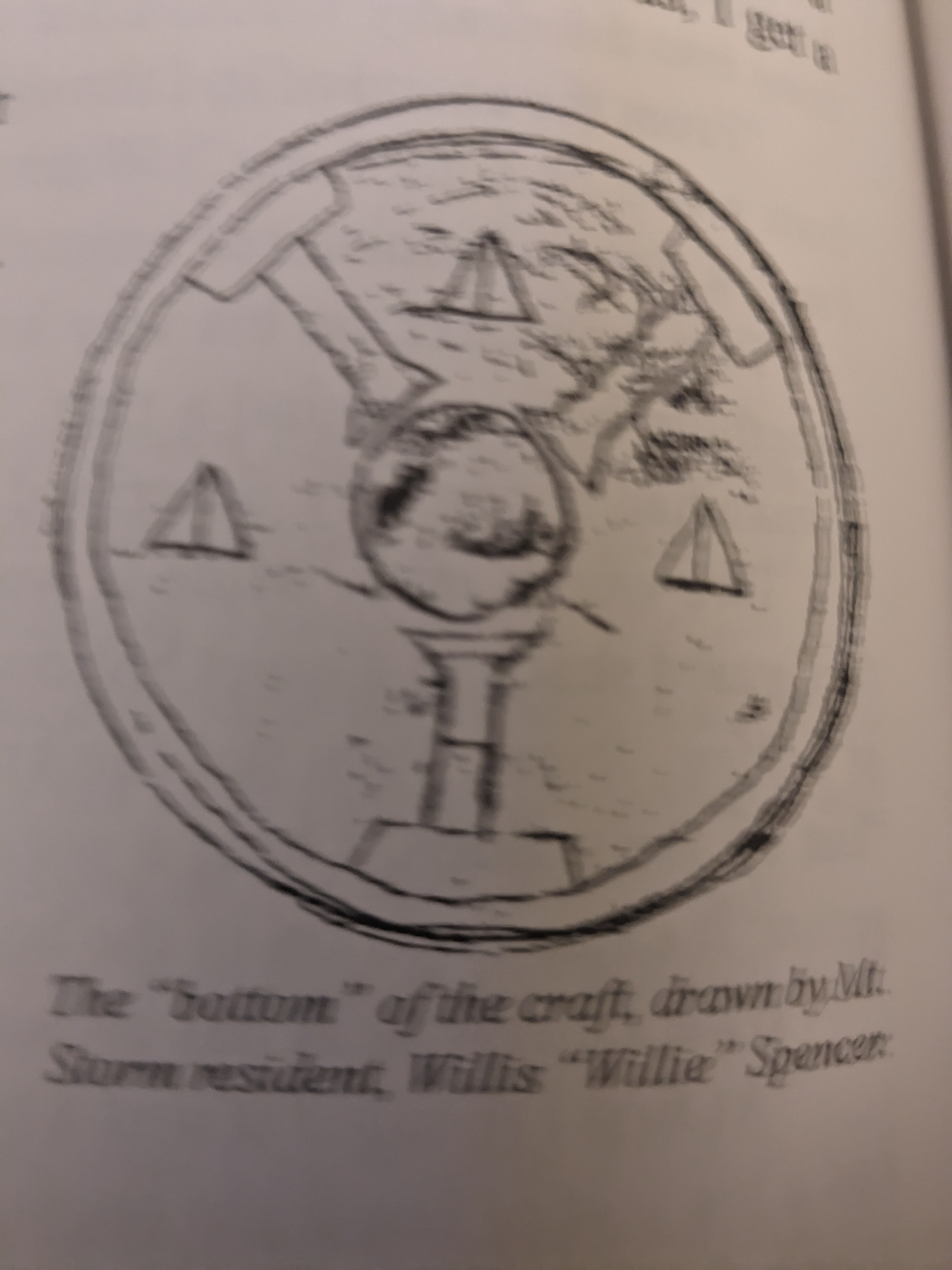
Things seemed pretty quiet for awhile, but two weeks later, Spence would have an experience he'd never forget. He was chilling out in his guard shack, listening to the radio and sipping on a cup of coffee. He was interrupted by what sounded like two pieces of metal slapping together. He looked out and saw what he assumed at first was a helicopter. A bright light came over the trees, and into view popped what appeared to be a spinning top-shaped craft, 40 to 50 feet in diameter and flying at a 60 degree angle. The main body of the craft was gray, but it was covered with rectangular windows in shades of red, green, orange and purple. The lighted rectangular windows would dim and brighten back up, each time making a 'va-room, va-room' sound. It was surrounded by a grated deck with a five foot high railing. A light came down, and a section of it turned orange as it stopped spinning.

Eyewitness Sketch of the
bottom of the craft
Source: WV UFOs by Bob Teets

Spence watched this craft for about three minutes, noting how beautiful it was, and how it evoked a happy feeling for him. Eventually, the craft went up and over a nearby mountain, out of sight. After this encounter, there were no additional sightings of that particular craft, nor the gray, hairy beast.  As seen in various other UFO cases (notably the Flatwoods Monster case of 1952), this case begs the question as to whether there was some sort of connection between the creature and the UFO. Was the creature an inhabitant of the UFO, either out exploring the West Virginia country-side (or perhaps even ESCAPING)? Did the occupants of the UFO send this creature down as a recon to see how it would react to our atmosphere? Or, were the UFO occupants sent to study this strange beast that happened to just be here naturally?

There could be no correlation at all between the sightings of the UFO and the sightings of the monster. It could all be a coincidence. But, after years of studying this phenomenon, I tend to believe that there is some over-arching force that links all this high strangeness together. Even today, many Bigfoot reports are accompanied by mysterious light anomalies and nearby UFO reports. I'll let you decide what to believe. Keep your eyes to the skies! 

**The information for this blog post comes entirely from Bob Teets' 1995 book, West Virginia UFOs: Close Encounters in the Mountain State.  There was a brief mention of this case in the West Virginia UFO Newsletter Volume 2, Number 11 (1996), but no additional information was given and unfortunately, I haven't found anymore substantial info on this case anywhere else.