Showing posts with label buried alive. Show all posts

Wednesday, October 16, 2019

Buried Alive in Hampshire County, WV

Before the practice of embalming was widespread, the fear of being buried alive was a very real one for many.  This story comes from a February 12, 1885 edition of a newspaper out of St. Louis, Missouri, although the event in question takes place in Hampshire County, West Virginia.  I found it shared on the West Virginia Heritage, History and Memories Facebook page and it appears to have been originally shared on the Hampshire History Facebook page.  It was noted there that the young woman did survive, but other newspaper articles stated that it was believed she'd be a 'lunatic' for life.  


ALIVE IN HER COFFIN
A Dreadful Occurrence in a West Virginia Village--Morphia
Special dispatch to the Globe-Democrat

SPRINGFIELD, W.Va., February 12--A terrible affair has just come to light on the levels near Okonoko.  Mary Cox, a well-known and popular young lady, residing near the mouth of the Little Capon River, was taken violently ill.  The physician diagnosed the case as one of neuralgia of the stomach and prescribed morphia. A dose was administered at once, and another was left, with instructions to give it in twenty-four hours.  For some as yet unexplained reason the second dose was given in a very short time. In an hour or two after, the death of Miss Cox was announced and neighbors prepared the body for burial, and two days later the deceased was interred.  At the funeral one lady insisted that Miss Cox was not dead and begged that a physician be sent for.  That night the dogs of a man living near the graveyard stationed themselves near the tomb and kept up a persistent howling.  The neighbors talked, and the next day the grave was opened, when to the horror of all, it was found that the girl had been buried alive.  The coffin presented a terrible sight.  The lining was torn from the sides of the casket, the pillow was in shreds, and the poor girl had literally stripped the clothing from her body.  Her hands and arms were torn and bloody, the lips were bitten through, and handfuls of hair lay about.  The girl had come to, and evidently a frightful struggle to escape followed.  The affair fills the community with horror.

Theresa's Note: I found this story, word for word, in several other publications, including this one from the Rock Island (Illinois) Argus. I also did a little searching to see if I could find any evidence that Mary did go insane (and who could blame her after that ordeal?), but didn't find anything substantial.  I did find several articles mentioning a Mary Cox from Harrison County who was deemed 'insane' and died at the Weston State Hospital, but the age range doesn't match up.  Either way, its a frightening story that I'm sure left an entire community, not to mention a young lady, shaken to the bone. 

Saturday, October 20, 2018

Buried Alive in Wilmington, NC

The temperature made a drastic drop this week here in West Virginia...and while I absolutely have no problem with it...it does make me a little nostalgic for summer vacation.  This year, my family visited Carolina Beach, North Carolina and spent quite a bit of time in nearby Wilmington.  On one of our excursions into town, we made a stop at the small, historic cemetery located behind St. James Episcopal Church.

You won't find a tombstone with his name on it, but records to indicate that a young man by the name of Samuel Joselyn was buried in this cemetery back in 1810.  Unfortunately, it doesn't appear that Samuel was actually DEAD at the time of his burial!

Samuel came from a wealthy family, which afforded him the opportunity for a good education and the leisure time to get together with young men of similar means and discuss philosophical and academic ideas.  One rainy evening, the discussion turned to the topic of the afterlife and the survival of the soul after death.  Samuel and his best friend, Alexander (Sandy) Hostler made a pact:  whoever died first would come back and contact the survivor.

The two young men probably weren't thinking much about that pact on July 4, 1809.  On that date, Samuel married Mary Ann Sampson of another wealthy Wilmington family, and settled down with the intent to open his own law practice in town.  Unfortunately, his marriage would be a short one.


On March 16, 1810, The Jocelyn's and several other wealthy families were vacationing at one of their nearby hunting lodges. Mary Ann and Samuel apparently got into a fight that evening, and Samuel, in a rage, fled the hunting lodge wearing only a thin coat.  Due to the poor weather and Samuel's apparent poor state of mind, a search party went looking for them.  It wasn't until two days later that he was found in the swamp, lying in 4 inches of icy cold water.  He had apparently fallen or was thrown from his horse.   

Family and friends were distraught as Samuel was laid to rest at St. James' graveyard soon afterward.  Sandy Hostler took the loss of his friend especially hard.  The grieving Sandy was horrified when on the night of Samuel's funeral, an apparition of the deceased young man appeared before him.  The apparition spoke, imploring Sandy to "dig up my body."  Sandy, shaken by the vision, assumed that the ghost was nothing more than a product of his grief and his sleeplessness.  And then, the apparition appeared twice more.  At a loss of what to do, Sandy sought the advice of Louis Toomer.  Louis reminded Sandy of the pact that Sandy and Samuel had made, which Sandy had completely forgotten about. 

Louis further theorized that Samuel had somehow hidden in the coffin some sort of proof of life after death, and that's why he was so insistent that Sandy open his coffin. So, after much deliberation, the two young men decided that it had to be done.  They would exhume their friend's body themselves.

The night came and the two met just outside the graveyard's gates.  As they completed their grisly task, it finally became apparent that Samuel had not hidden any proof of the afterlife in his coffin.  It was much, much worse.


Samuel's ghost DID contact Sandy that first night, and on two subsequent nights, but it wasn't to share proof an afterlife.  It was an attempt to SAVE his life.  Samuel's face wore a twisted look of sheer terror.  His fingers had scratched the coffin lid until they were nothing but bloody stumps, bones exposed.  Samuel hadn't died in the swamp; he had died a horrifying death buried alive.  Perhaps by the time his apparition had come to Samuel, it had already been too late.  Or, perhaps what was his 'ghost' was actually his soul temporarily leaving his body in order to seek help.

Sandy is also long gone now, but Samuel's ghost is still scaring the residents of Wilmington.  Before the fence and the security cameras, locals would scare themselves by daring each other to lie atop of Samuel's grave, ear to the ground, for one hour.  Legend states that no one was ever able to last the entire time without fleeing.  Others refuse to even walk past the graveyard at night fearing they might hear the muffled cries of Samuel Jocelyn, reliving the horror of being buried alive.

*You can read more about Samuel Joselyn's story in the book, Ghosts of Old Wilmington, by John Hirchak!  The church is also one of the potential stops on the Ghost Walk of Old Wilmington Ghost Tour!*

Blog Bonus!
On Monday, I shared a blog post about songs based on real paranormal events and popular ghost stories.  One of my readers, the awesome Mr. Lewis O. Powell, IV who runs The Southern Spirit Guide, an awesome blog about ghostly goings-on in the Southern US, shared this song with me!  Sam Jocelyn's Ghost is a musical re-telling of the story by the ETSU Bluegrass Pride Band.  Definitely give it a listen!  (Here's the direct YouTube link in case the video below won't play.)


Tuesday, October 2, 2018

Happy Old Man's Day!

Ghost lore is full of tales about people being buried alive.  In a time before modern medical technology and widespread embalming, many unfortunate souls were believed to have been buried prematurely...only to awake inside their own cold, dark coffin. More often than not, despite whatever supernatural message they tried to pass on to friends and loved ones about their plight, these occurrences ended with a tragic and horrifying death.

Fortunately for Matthew Wall of Braughing, England, he was one of the lucky few to avoid a similar fate!

Matthew Wall was a farmer who lived in the area during the 16th century.  As a young man, it is believed he slipped into a coma, caused by an epileptic episode.  Believing Matthew to be dead, his family and friends prepared him for burial.  The funeral procession, complete with Matthew in his wooden coffin, began the journey down Fleece Lane from his home to the local church, St. Mary the Virgin.  This is where fate would step in.

It was October 2, 1571 and the road was covered in damp, fallen autumn leaves.  One of the pallbearers carrying Matthew's coffin slipped on the wet leaves, causing the coffin to fall to the ground.  The jolt was enough to shake Matthew out of his coma and he began pounding on the side of the coffin with his fist.  His life had been saved, and a year later, Matthew became a husband.


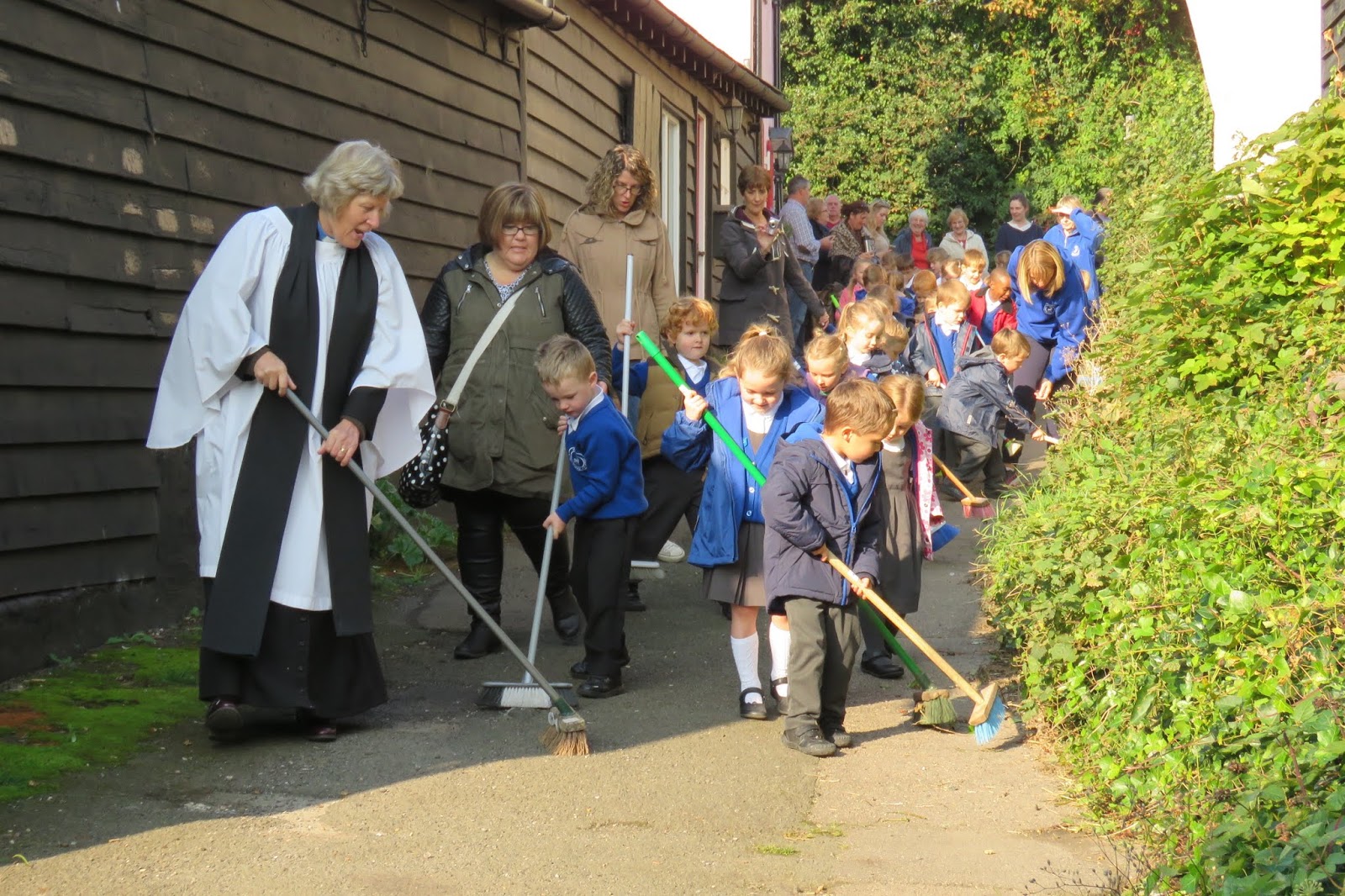
But, no one can live forever and Matthew did die (for real this time) in 1595.  Before his death, however, Matthew left instructions in his will for the village to commemorate the anniversary of his 'first death' each year by ringing of the church bells and giving Fleece Lane a good sweeping.

The tradition continues on to this day. Each October 2nd, the village gathers outside the Golden Fleece to hear the local vicar tell the tale of Matthew's near mishap.  The village school children then take to the street with brooms, giving Fleece Lane the required sweeping as per Matthew's will. The church bells are rung, prayers are said, songs are sung, and sweets are distributed.  A small graveside service at Matthew's final resting place concludes the festivities of Braughing's Old Man's Day for another year. 

Photos and information for today's blog come from the Calendar Customs website. 


Sunday, March 23, 2014

Buried Alive in Charleston, WV

Burial vault designed to allow those prematurely buried to free themselves

Paranormal research and ghost-lore are filled with tales of people being buried alive.  In fact, during the Victorian era and earlier periods, before embalming was a widely accepted practice, the fear of being buried alive was so great that a host of inventions, such as safety coffins outfitted with bells and air chutes, became almost a norm to those who could afford them.  Sources claim that at least 30 patents for different safety coffins were issued in Germany alone during the 18th century.  However, in the 1960s, which was apparently a very weird time in history, being buried alive took on a more Houdini-esque quality as normal, everyday people shoved themselves into glass coffins and went underground as publicity stunts and tourist attractions!

Not to be outdone by the rest of the world, here in little Charleston, WV we had not one, but FOUR people buried alive in two separate stunts going on concurrently!

 I wasn't personally around in 1968, so my knowledge of these events only came about yesterday when I literally accidentally stumbled upon the following newspaper article. I've added some additional details below.  I hope you enjoy this story as much as I did!

Bill White in Austin, Texas 
From: The Charleston Gazette
Friday, June 14, 1968

LIVE BURIAL TRIPLE-HEADER SLATED TODAY
By Pamela Brick, Staff Writer

Well, Charleston is now the supreme, unquestioned, undisputed world capital of the bury-people-alive business.  Promoters announced Thursday they intend to plant three "earthonauts"--a man and two women--in a single box eight feet under a Summers Street parking lot at 7 p.m. today.

There will be wooden partitions between them, "but," said one of the women, "Country Bill says he is going to take a saw down with him."

June Estep, 23, a Charleston go-go dancer and Betty Jones, 34, a grandmother and cocktail waitress, both of 223 Truslow St., will join with "Country Bill" White, 34, a country and western singer and professional burial subject from Clearwater, Fla., as the latest volunteers for burial alive.

Along with Mrs. Patricia Haverland, a Charleston divorcee who is buried at the Cherokee Trading Post on U.S. 60 east of town, they will give the city an underground population of four.  "This is the first known time anywhere that three persons have been buried together," said White.  "We challenge anyone in the world to match our stay underground."  White, who will be entering the grave for the 39th time since 1964, said the three will attempt to stay down for 102 days.  The women, neither of whom has been buried before, said they would like a stay under for at least 63 days.  "If we can stay down that long, we'll work from there," said Mrs. Jones.  

White set a world record of 63 days and 22 hours at Austin, Tex., when he came up April 26.

Why be buried alive?

Mrs. Jones said, "I have always liked to do things that are different and unusual."  She did add, however, that this is the first unusual thing she has done.  Mrs. Estep said she didn't see how anyone could live underground that long, so she's trying it to find out.

The coffin will be divided into three equal parts 2.5 feet high, 2.5 feet wide and 5 feet 10 inches long.  "Each container will have a separate lid," said White.  "This way each person may be brought out if needed without opening the entire coffin."

"Country Bill," who will be placed in the middle compartment, said each person will have his individual phone and radio and will be able to talk to the others by either yelling or phoning.  The three will be visible to the public through a chute.  It will be possible to see all three at one time, said White.

Mrs. Estep, who has a seven-year-old son living with her mother in Chicago, Ill., sat nervously toying with a piece of paper as she voiced her only fright.  "The only thing that scares me," she said, "is the sound of that dirt falling down on top."


Summers Street, ca 1960, from wvgazette.com

So, obviously this is a fairly intriguing piece of Kanawha Valley history which I plan on doing more thorough research on in the near future, but I have managed to find out a FEW things by searching online.  Unfortunately, it doesn't look like Country Bill's stunt ever got approved!  There were fears from Charleston's parking captain of the spectacle causing traffic problems and safety issues.  Then, in a newspaper article dated from June 30th, it states the project was halted by the city building inspector.  The inspector deemed the "coffin" to be a living space, thus requiring it to have 320 square feet of space, a bathroom, heat, running water, and at least two exits.

But, there was good news for Patricia Haverland!  Haverland was buried at the old Cherokee Trading Post on Rt. 60, which is close by the Daniel Boone Park....right about where the Moose Lodge is located today.  Since this location was outside of Charleston city limits, the building codes didn't apply to her.  However, her goal wasn't immediately met.  She initially had to be taken out after only 11 days due to an illness, but she persevered and went back under.

Tourists could pay a nickel to view her down in her glass-topped coffin and while she didn't beat Country Bill's record, the mother of three in her mid-30s did manage to raise $4800 for her cause of taking in and helping out unwed mothers.  As for Country Bill White, he was still alive in 2005, and was still burying himself alive to raise money for charity and to promote car dealerships.  As of 2003, he was still in the Guiness Book of World Records, after having crushed his own previous record set in Texas.

1987 Interview with Country Bill White