
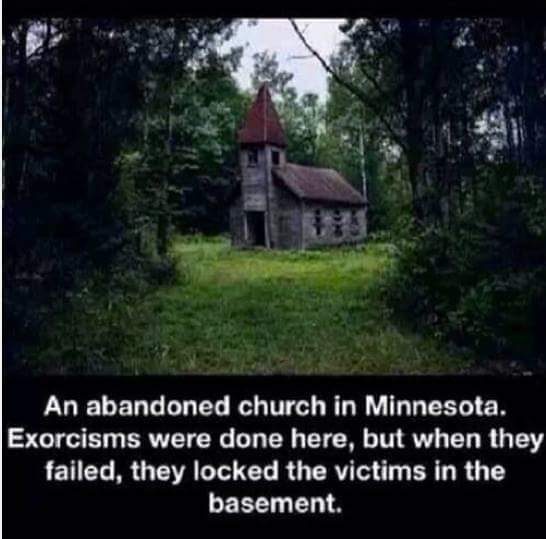
You might have seen this image before. It's a favorite on Pinterest as well as on many different Facebook pages. A creepy, dilapidated church out in the middle of nowhere just HAS to have a suitably creepy back story, and this seems to do the trick. Furthermore...unlike many of these images with accompanying outrageous text, this story sounds like it COULD be true.
It's no secret that throughout history, not much was known about mental illness. A favorite scapegoat was obviously that people suffering from such things as schizophrenia and other mental illnesses were, in fact, under demonic possession. And, its no secret that historically, the treatment for the mentally ill were sometimes worse than just living with the affliction itself! Many families, for a variety of reason, chose to keep mentally ill loved ones out of asylums. However, if they were a risk to themselves or others, they sometimes had to be restrained or locked away. Sometimes they were simply locked away from the outside world out of shame and embarrassment. In any event, its not too far of a stretch to believe that mentally ill persons who were assumed to have been possessed by demons would fail to be 'cured' from an exorcism, and thus locked away for safety's sake. I don't necessarily think it happened at this church, though...
 |
| From the Church's FB page |
The church wouldn't be used all that much. By the 1950s, the small Estonian population was moving into the cities, and 1964 marked a 50 year reunion celebration that effectively ended regular church services as the small church in the woods. In 2011, the current owner, Bill Rebane, claimed that a group of about 20 still worshiped at the site, weather permitting, yet the small building was in an obvious state of disrepair.
However, recent posts to the church's Facebook page show that care is being taken not only to preserve the church, but to restore it to its former glory! There Facebook page, along with a blog called Shunpiking to Heaven, have some awesome photos and history---just no mention of any failed exorcisms on the site! Please check them out for more information.
Church Facebook Page
Shunpiking to Heavens Backroads Blog

Sommige foto’s blijven op internet steeds opnieuw opduiken omdat ze precies de juiste sfeer hebben. Een **verlaten, vervallen kerk midden in een afgelegen landschap** is daar een perfect voorbeeld van. De donkere uitstraling en het verlaten gebouw maken het bijna onmogelijk om niet te denken dat er een bijzonder verhaal achter schuilt.
ReplyDeleteOp Pinterest en Facebook worden zulke beelden vaak gecombineerd met mysterieuze teksten en dramatische verklaringen. Het interessante is dat sommige verhalen zo geloofwaardig worden verteld dat je even vergeet dat een groot deel ervan misschien nooit is bewezen. Juist die twijfel maakt dit soort beelden zo aantrekkelijk.
De aantrekkingskracht zit vaak niet alleen in het gebouw zelf, maar in de verbeelding van de kijker. Een kapotte deur, donkere ramen of overwoekerde muren kunnen al snel het idee oproepen van een verdwenen gemeenschap, een verlaten geheim of een gebeurtenis uit een ver verleden.
Toch is het verstandig om onderscheid te maken tussen een **mooie urban legend en controleerbare geschiedenis**. Zonder betrouwbare bron is het onmogelijk om te weten welke details werkelijk bij de locatie horen en welke later aan het verhaal zijn toegevoegd om het spannender te maken.
Dat betekent echter niet dat het beeld minder interessant wordt. Soms is juist het onbekende onderdeel van de charme. Een mysterieuze foto kan mensen ertoe aanzetten om onderzoek te doen naar oude gebouwen, lokale geschiedenis en vergeten plaatsen.
Wie naast mysterieuze verhalen ook andere digitale content en online entertainment wil ontdekken, kan een kijkje nemen op https://roadchicken.nl/.
Uiteindelijk laat dit soort internetverhalen vooral zien hoe sterk beeld en storytelling samen kunnen werken. Een verlaten kerk hoeft misschien geen gruwelijke geschiedenis te hebben om fascinerend te zijn – soms is het mysterie zelf al genoeg.